

From Mainz into the world
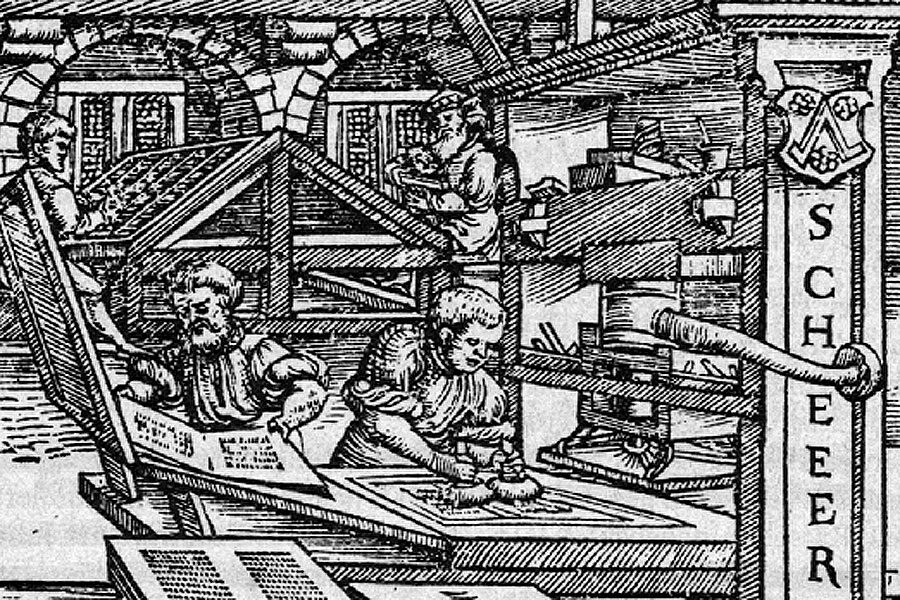
The oldest printing houses and publishing houses
When Johannes Gutenberg died in February 1468, his art of printing, which had initially been kept secret, had already spread far and wide: independent printing shops had opened not only in Germany, but also in neighboring countries.
Considering that Gutenberg's famous Bible was not completed until 1454 and that only 13 years had passed since then, the spread of the art of printing seems like an explosive event.
Even in our fast-paced media age, it usually takes several years for a major innovation to actually conquer its market; just think of the introduction of the CD.
It was a rather unexpected event that triggered this rapid spread: after individual printer's apprentices had already left Gutenberg, who was in a legal dispute with his financier and ultimately even lost his workshop, a large exodus followed in Mainz in 1462, six years before Gutenberg's death. The dispute between the incumbent Archbishop of Mainz, Diether von Isenburg, and Adolf von Nassau, the candidate favored by the Pope and the Emperor, was resolved in a manner typical of late medieval feuds: The Nassauers took Mainz by force, expelling the incumbent archbishop along with a considerable number of unpopular Mainz citizens, including several of the printers working in the workshops of Gutenberg and his competitors Fust and Schöffer.
Setting up an efficient printing shop was not only very capital-intensive, but it was also only worthwhile if there was a corresponding market. The Mainz printers therefore sought refuge in cities where there was a daily demand for books thanks to brisk trade or the presence of universities.
This circumstance made most cities appear unattractive – in some cases, it was necessary to travel relatively far. As a result, printing shops sprang up in quick succession in Heidelberg, Strasbourg, Augsburg, Basel, Ulm, Nuremberg, and Vienna in the south, in Cologne and Leipzig in central Germany, and in Lübeck in northern Germany. Bishoprics also became printing centers, as there was always a demand for liturgical literature: Würzburg, Regensburg, Bamberg, Freising, Eichstätt, Passau, Münster, Merseburg, Breslau, Schwerin, and Meissen thus acquired printing workshops at an early stage.

German media technicians abroad
The first work printed beyond the Alps was completed in 1465 at the Santa Scolastica monastery in Subiaco, Italy. It was printed by Konrad Sweynheym and Arnold Pannartz. Sweynheim, who had originally been a cleric in the Archdiocese of Mainz, had probably already learned the printing trade in 1462 at the Fust-Schöffer printing house in Mainz. The first workshop in Rome run by German printers was established in 1464/65. Once again, Sweynheim and Pannartz, together with Ulrich Han from Ingolstadt, were the printers on site in the Holy City.
Of the more than 40 printing shops that were established in Rome alone before 1500, 25 were German-owned. The announcements of the Curia, sermons, and political texts guaranteed a good order situation in Rome. However, Venice was at the top of Italy: 150 printing shops produced around 4,500 book titles and other printed matter by around 1500. The first in Venice was Johannes de Spira (= von Speyer), who is mentioned in Mainz in 1460/61. In 1469, the first book was published in the lagoon city, a classic: Cicero, "Epistolae ad familiares."
While in Italy the Church was a strong driving force behind book printing, in Paris it was primarily the needs of the Sorbonne that promoted the introduction of book printing. Professors at the "Higher School" there secured funding for the establishment of a printing press and brought in three second-generation German printers from Colmar, Constance, and Strasbourg.
In the south of France, there were a number of itinerant printers from Germany, some of whom also crossed the Pyrenees to Spain. Johannes Numeister was one of the first: he had first brought printing to Foligno in Italy (since 1470), then turned to Perugia and later went to Albi and Lyon in France.
In 1473, the Cologne printer Lambert Palmart started up a business in Valencia, Spain; as early as 1490, the first work of local significance, the chivalric romance "Tirant lo Blanch," was published there in the Valencian language by the Zwickau printer Nicolaus Spindeler.
By 1500, there were already around 260 locations in Europe with around 1,120 printing shops, which had published 30,000 works and printed 20 million copies within four decades.
After several millennia of handwritten tradition, this was a media change whose significance can be compared to the development of electronic media in our time.
And what has become of the invention after around 450 years? At the 49th International Book Fair in Frankfurt in October 1997, more than 9,500 publishers once again presented more than 320,000 new titles.
Christoph Schlott
Team "Mainz. Gutenberg 2000"