Highlights
The permanent exhibition at the Gutenberg Museum is rich in unique treasures and exciting stories. Don't miss these highlights!
1. the Gutenberg Bibles in the treasury

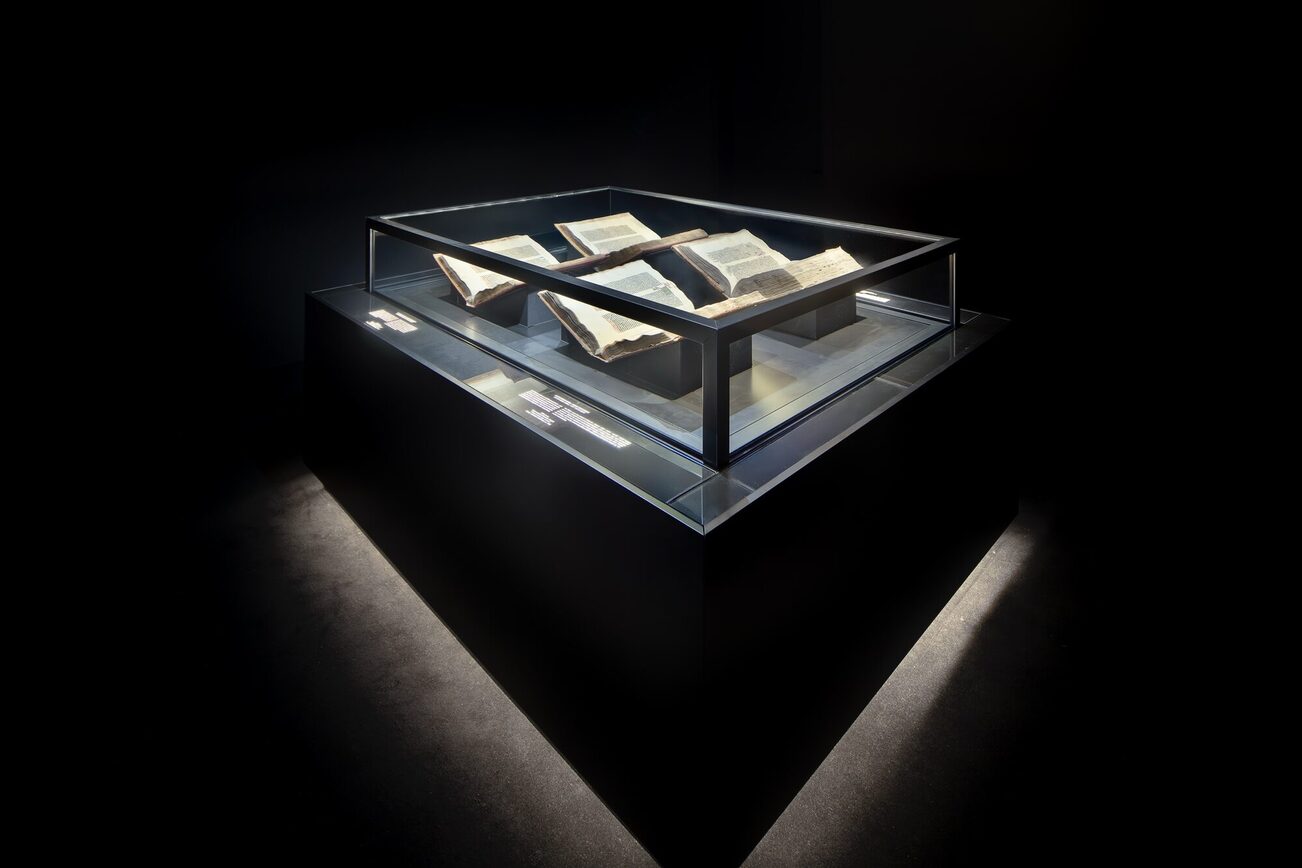
The centerpiece of the collection and arguably its most valuable treasures are located in the treasure chamber of the permanent exhibition: two Bibles from Johannes Gutenberg's workshop. Both the complete two-volume Shuckburgh copy (1452-55) and one volume of the Laubach copy (1452-55) can be admired in the vault and compared with each other.
To this day, the Bible remains Johannes Gutenberg's magnum opus. The technique of printing with movable type, which he invented, achieved outstanding quality in this work. The development of printing subsequently led to a veritable revolution in science, economics, and culture, becoming a milestone in modern times and human history.
The Gutenberg Bible remains one of the most beautiful printed books in the world to this day.
Location: Ground floor, treasure chamber
2. the block book "Biblia Pauperum"

The Gutenberg Museum now has three different block books, which are important testimonies to the experimental phase of early book printing. One of them is the Biblia Pauperum, also known as the "Poor Man's Bible." The 40-page block book was probably produced in southern Germany around 1460–64. Block books date from the transition from manuscript culture to letterpress printing and are of particular cultural and historical value. For block books, motifs and text were usually carved together onto a wooden block and then printed onto paper. In contrast to Gutenberg's invention, printing with individual movable letters, the production of block books involved much more effort and was not able to establish itself in the long term. The printing blocks had to be laboriously carved for individual pages, and mistakes were almost impossible to correct. Even though block books were produced using a reproduction process, only a few copies have survived, and these are often incomplete. They are even rarer to find for sale. The newly acquired Biblia Pauperum is one of the few complete versions and is in an outstanding condition. The Biblia Pauperum purchased for the Gutenberg Museum is particularly valuable and unique in Germany due to the completeness of its pages and its excellent, uncolored condition. Its provenance can be traced back to the first half of the 19th century.
Location: Ground floor, treasure chamber
3. the Gutenberg workshop

The first floor is dedicated to printing technology and book production. Here, visitors can experience how Gutenberg's invention—printing with movable type—works in practice. Two platforms each feature a replica of a historic printing press. In the workshop, type casting, typesetting, and printing on wooden Gutenberg presses are still demonstrated vividly and expertly to this day. The reconstruction of the Gutenberg press is based on woodcuts from the 15th and 16th centuries.
Hourly demonstrations take place throughout the year in the Gutenberg workshop. All information can be found in the regular events section.
Location: 1st floor, "Technology of Printing"
4. the "Columbia Press" of 1824

At the end of the 18th century, the first printing presses made entirely of metal were built. Their sturdy construction also allowed the printing of heavy forms using a pull bar.
Following Wilhelm Haas (Basel, 1772) and the Earl of Stanhope (London, around 1800), the American George Clymer succeeded in building such a press around 1810. His "Columbia Press" reduced the amount of force required for printing so much that even children could operate the press, as contemporary advertising rightly promised.
In addition to making work easier for the printer, the "Columbia" also had a magnificent appearance, which contributed significantly to its success and popularity. The counterweight on the upper press beam is designed as a griffin with two printer's balls, the heraldic animal of the printers' guild. In 1817, George Clymer obtained a patent in England and built and sold his presses on the European market from there.
The Columbia press in the Gutenberg Museum is one of the few that were manufactured under license in Germany at the Zorger ironworks. In conjunction with the emergence in the 1920s of inking the printing forms with hand rollers instead of the conventional printer's balls, the hourly output increased to 300 to 400 prints.
Location: Ground floor, Media History
5th picture journey in the stairwell

The pictorial journey illustrated by Jörn Kaspuhl shows the history of the Gutenberg Museum's origins and its significance for the city of Mainz. Important milestones, such as the founding of the museum in 1900 and the visit of Queen Elizabeth II in 1978, vividly illustrate to visitors how the Gutenberg Museum has developed into a hotspot for special personalities and give viewers an impression of how lively the World Museum of Printing Arts is as a place of encounter.
Location: Stairwell
6. city model

The new city model shows Gutenberg's most important places of activity in medieval Mainz. Built as a 3D model, it is also accompanied by a projection about Gutenberg's life.
A "blank page" from the museum's collection serves as the narrator and animation for this journey through time.
Location: Ground floor, prologue "Johannes Gutenberg"
7 The Gutenberg Museum - a media-historical perspective

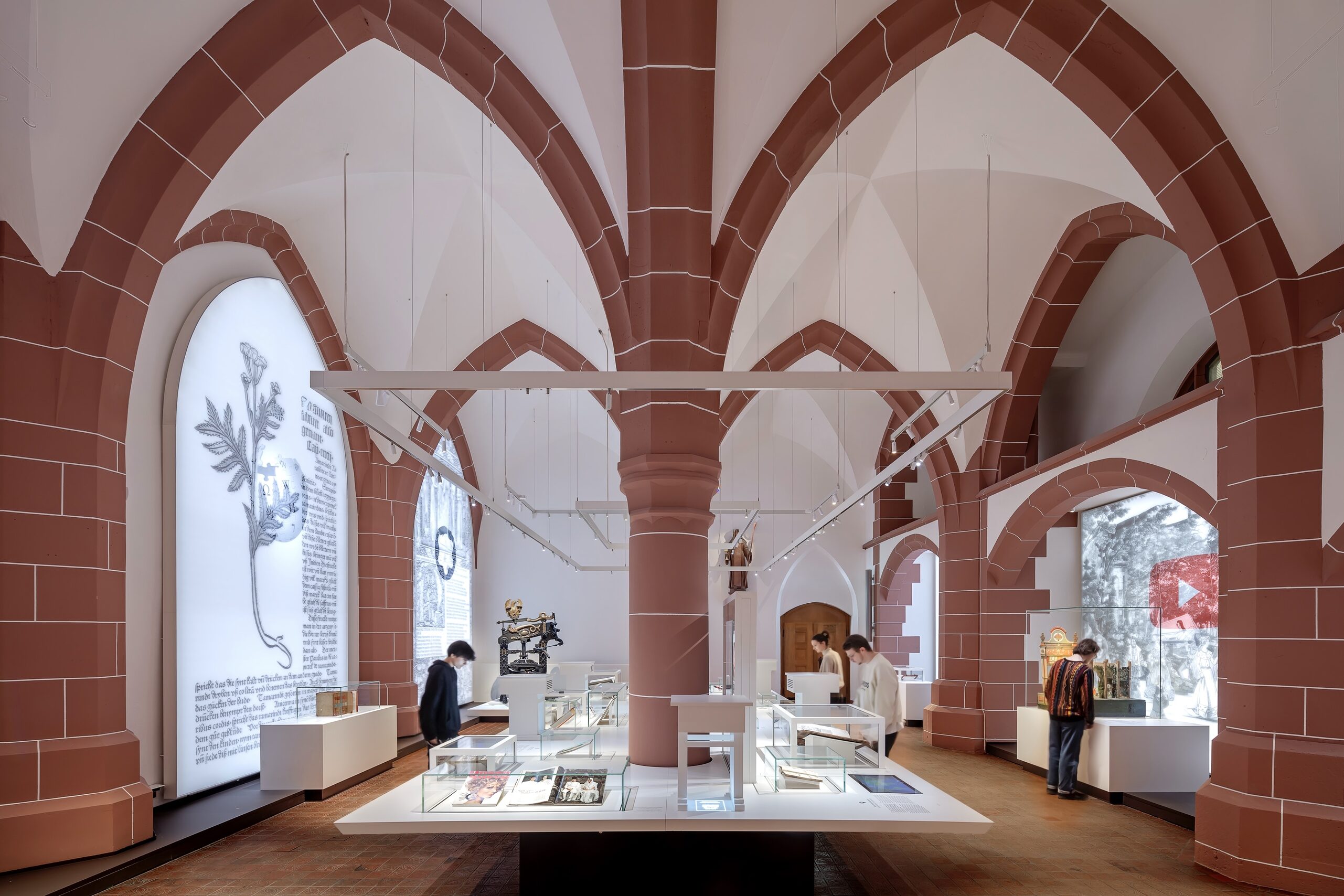
In the nave, the largest exhibition space, six thematic areas are presented based on today's media and their use: "Describing the world," "Passing the time," "Shaping opinion," "Unfolding splendor," "Creating knowledge," and "Cultivating image." Each theme is assigned an object from the Gutenberg Museum's collection in order to compare media developments then and now. At the interactive selfie station, visitors can take a self-portrait against the backdrop of a printing workshop; this is then printed on a media card. Our guests can also place the media cards under various media stations, which provide further information about the exhibition.
Location: Ground floor, "The Gutenberg Museum – a look at media history"