

After Gutenberg

The invention of lithography 200 years ago
From lithography to offset printing
"Necessity is the mother of invention," as the saying goes, and it is thanks to financial hardship that we owe the invention of a printing process that emerged 200 years ago and quickly rivaled the traditional methods of letterpress and intaglio printing: lithography (flat printing).
Alois Senefelder (1771–1834), a law student with a penchant for writing, was looking for a way to reproduce and sell his own plays as cheaply as possible. He couldn't afford his own printing press and type, so he searched for an alternative printing technique. The result was "printing from stones."
We do not know when he came up with the idea or when he first set his own printing press in motion. In any case, the song lyrics "Brand von Neuötting" appeared in 1797, presumably the first work produced using the new technique.
Senefelder himself christened his invention "Chemische Druckerey" (chemical printing), but it became known by the name "lithography" (Greek: "lithos" = stone; "graphein" = to write), which is still commonly used today.
The basic idea is both simple and revolutionary: is it really necessary to engrave text and images in relief on a printing plate, or would a "flat" printing plate work just as well?
Senefelder achieved his desired goal by taking advantage of a natural process: water and grease repel each other! So he prepared a completely flat stone slab so that he could apply the desired lettering and images in reverse with greasy chalk or ink directly onto the stone, then moisten it with water and apply greasy ink. The ink did not adhere to the wet surface of the stone, of course, but it did adhere to the greasy lines of his drawing!
The number of prints was in principle unlimited, and their reproduction was very fine and accurate in detail. Senefelder
found the most suitable stone in the limestone quarries near Solnhofen. Today, they are still known primarily for their world-famous fossils.
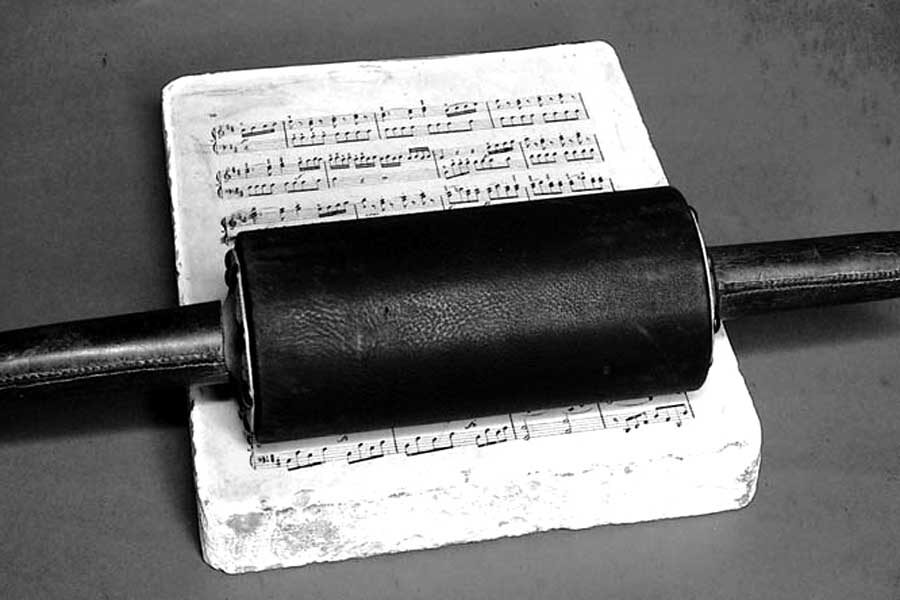
Via Munich and Offenbach into the world
Senefelder initially used his invention to print sheet music for his financial backer, the court musician Gleißner. The Offenbach
music publisher André quickly recognized the potential of the new process, signed a contract with Senefelder, and thus helped lithography conquer the world.
Lithography printing shops soon sprang up abroad, and Senefelder himself published essays and books recommending the types of printed matter he considered suitable for lithography: texts, sheet music, maps, tables, circulars—in other words, commercial art—and reproductions of works of art.
The artistic graphics that we generally associate with lithography today did not emerge until decades later.
Senefelder's long-term success was due to three advantages: the durability of the printing plate (stone), the extraordinary speed with which the printing plate itself could be processed, and the resulting price advantage over conventional printing processes.
No delicate printing plates could be damaged, the printing plate was quick and easy to produce by simply drawing in reverse, print runs were high, and the stone could be used for other, additional prints by simply removing the layer that had already been processed and was no longer needed!
Technical improvements such as color printing (chromolithography) and better presses followed, so that soon only one crucial question remained: How could the heavy stone slabs be replaced with lighter substrate material?
The answer came in 1834: zinc plates. This step led to the invention of offset printing in 1846/47, in which thin metal plates are bent and then stretched onto a cylinder. The cylinder rotating in the printing press made it possible to increase the printing speed once again and paved the way for our modern printing lines, which spit out thousands of copies of newspapers and magazines every minute – thanks to Senefelder.
Team "Mainz. Gutenberg 2000"