
Maple-leaved plane tree
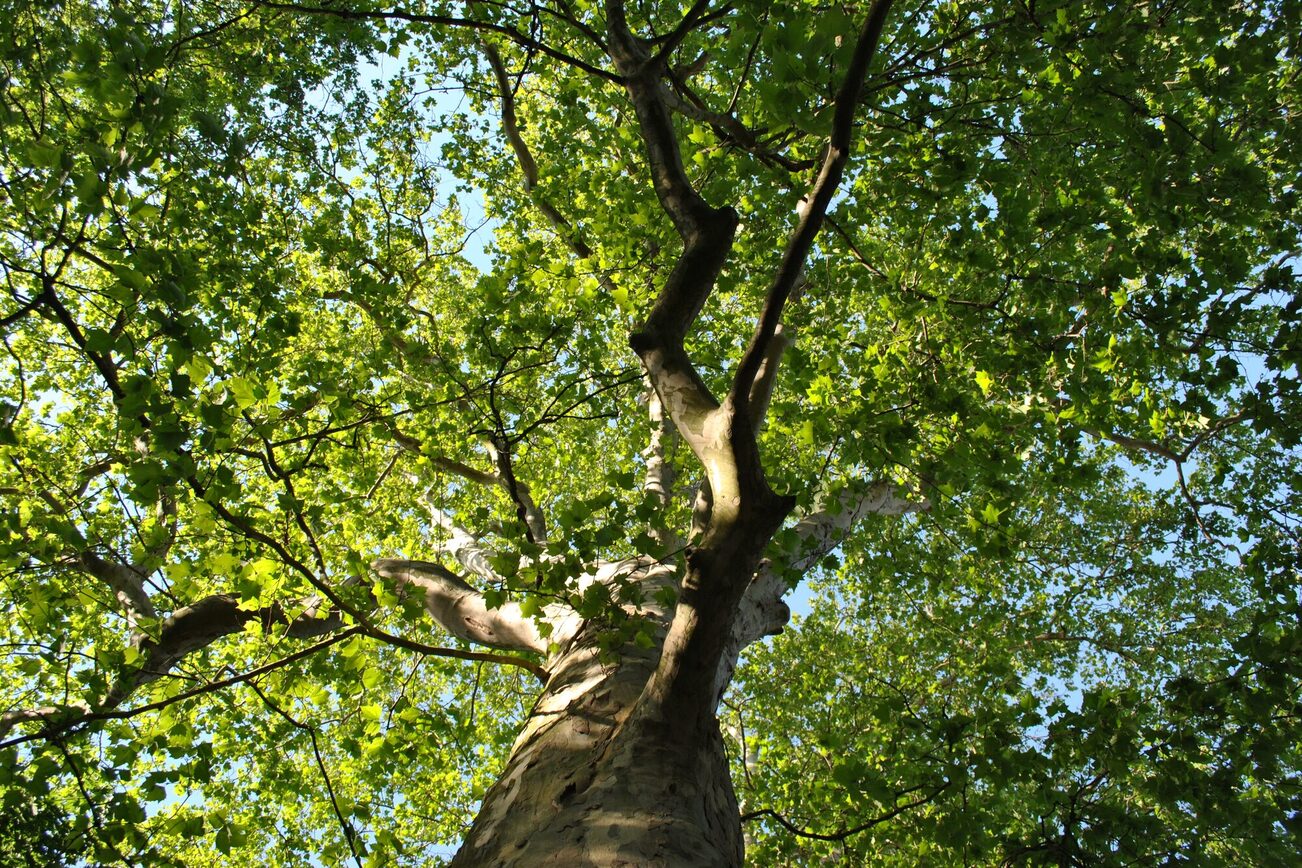
The plane tree has long been a very popular urban and street tree in many countries around the Mediterranean. Its tolerance to dry, hot climates, exhaust fumes, and compacted soils makes it ideal for planting in urban areas. It also tolerates pruning extremely well, so its rapid and expansive growth can be slowed down if necessary.
With age, the crown often develops more in width than in height. A typical feature of the plane tree is its bark, which peels off in large plates in some cases. This gives the tree a scaly appearance ranging from gray to greenish to yellowish-white. This is particularly noticeable in the winter months when the tree has no leaves.
- Origin: Cross between P. occidentalis x P. orientalis
- Height: 30–45 meters
- Leaves: maple-like, usually 5-lobed, shiny dark green, yellow autumn color
- Flower: inconspicuous, appears at the same time as the leaves
- Fruit: usually 2 balls with a diameter of approx. 3 cm together on a 15–20 cm long stem; spherical, brown; usually remain on the tree over winter
- Soil/location: very adaptable to soil; prefers deep, slightly loamy, neutral soils
- Special feature: So-called "umbrella plane trees" are becoming increasingly common in German cities. Along promenades or in confined spaces. These are plane trees that have been extremely well trained. In nurseries, the trees are grown to their final trunk height. From the first branch onwards, the branches that sprout here are then bent horizontally. The annual shoots that rise towards the sky every spring must be cut back completely every year if possible.
If the trees are planted in groups with the necessary spacing, a denser canopy is created from year to year, providing shade from the summer heat. Umbrella plane trees can be found on both sides of the Rhine. For example, along the Rhine promenade in Mainz or in Oestrich-Winkel on the Rheingau cycle path, accompanying the river.