
Bladder ash
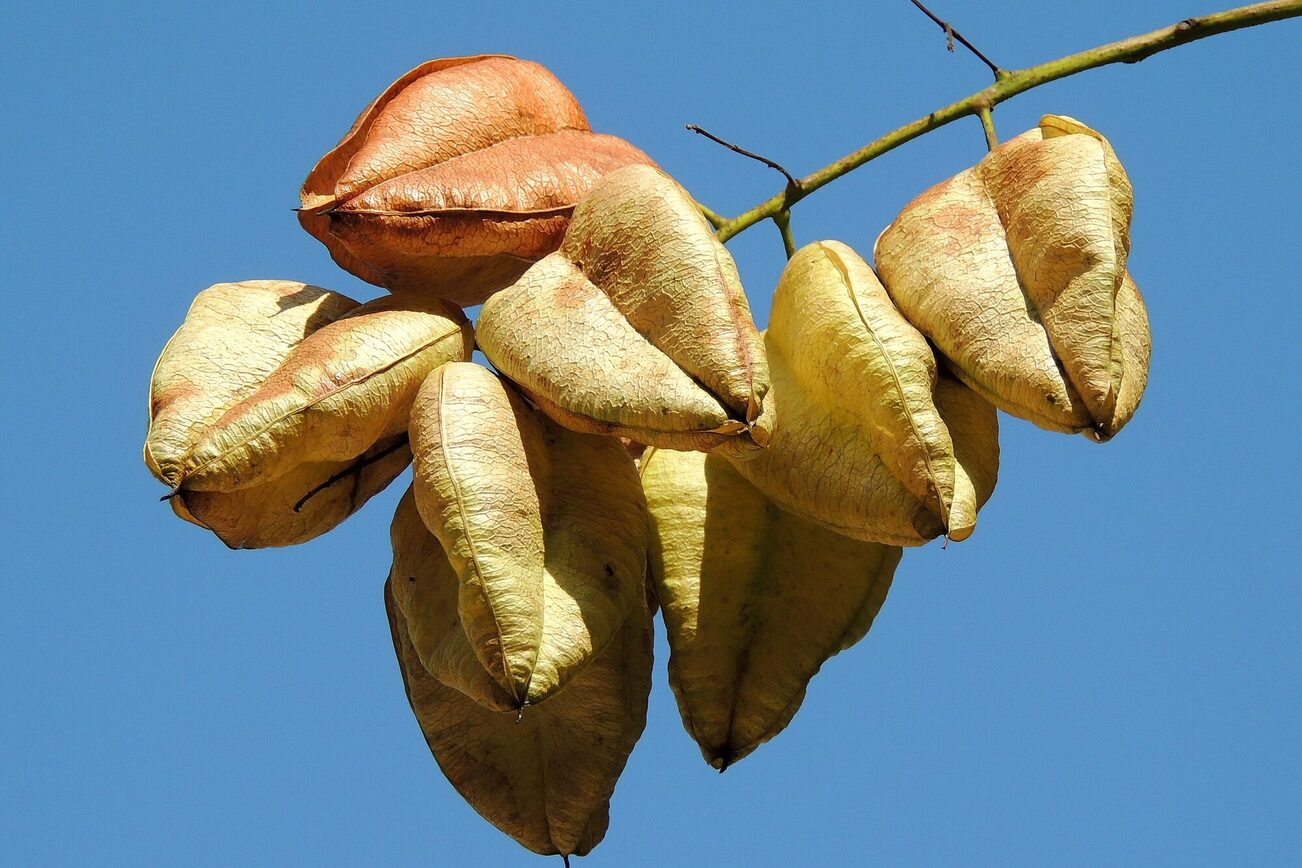
The bladder ash, also known as the panicle bladder tree, originates from Asia. With a growth height of up to 15 meters, it is one of the smaller trees. In our latitudes, it usually does not grow taller than 8–10 meters and can also be grown as a large shrub with multiple trunks. With its slightly crooked, twisted growth, it looks picturesque and is particularly suitable for use in gardens with limited space.
The bladder ash owes its German name to its fruits. These are bladder- or lantern-like fruit husks that appear in large quantities on the tree in late summer/autumn, depending on the location. They are up to 5 cm long, initially green, turn brown by autumn, and remain on the tree throughout the winter.
- Origin: East Asia, Japan
- Growth height: up to 15 meters
- Leaves: pinnate; up to 35 cm long and divided into 7–15 dark green, unpaired pinnate leaflets; leaflets ovate with pointed tips, autumn color bright yellow to orange-brown
- Flowers: July–August; large, upright panicles; approx. 1 cm in size; yellow
- Fruit: capsule fruits; initially yellow-green, later brown, bladder-shaped, lantern-shaped shell; each contains 3 black, spherical seeds
- Soil/location: tolerates heat and drought without major problems; prefers dry to fresh, well-drained soils