
Ball maple
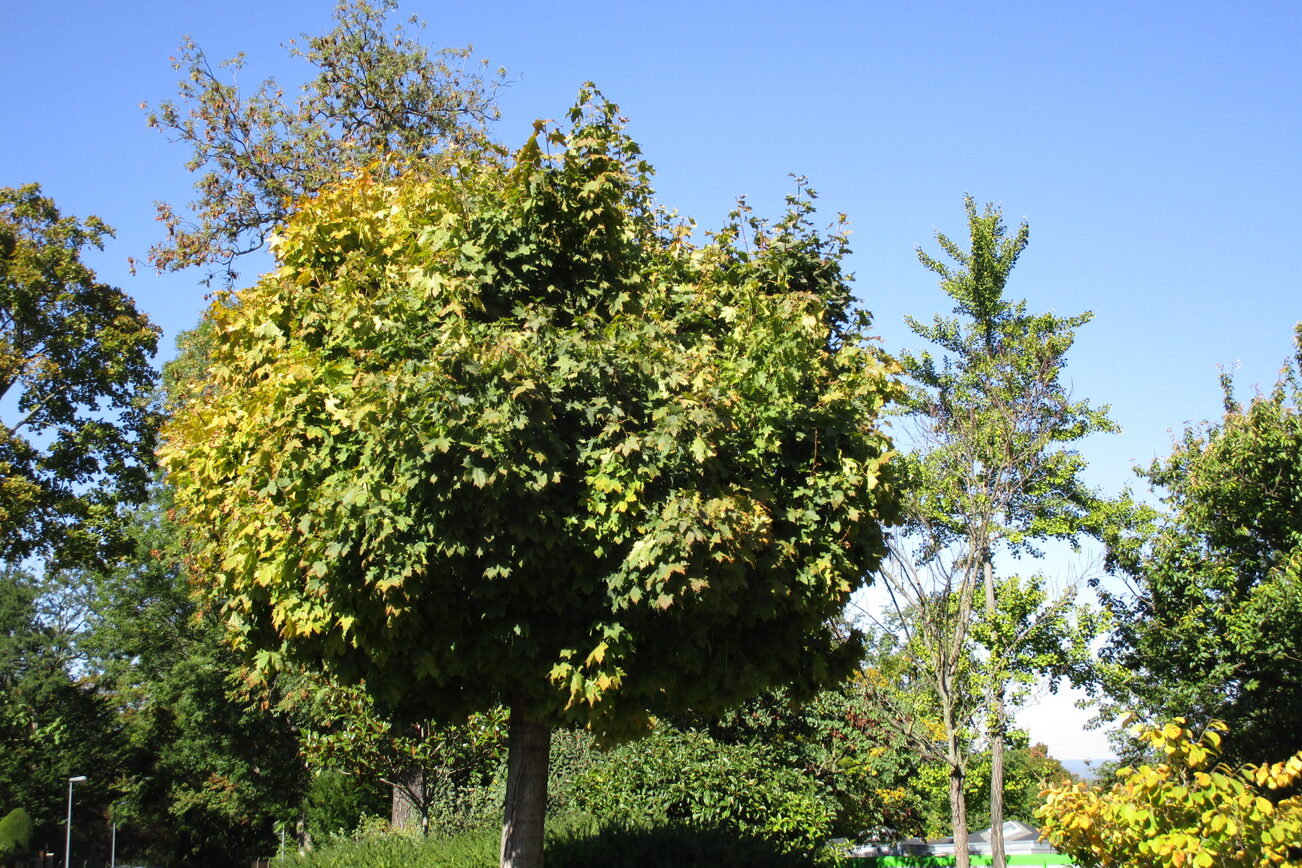
The globe maple should actually be called the globe-shaped Norway maple, as it is a cultivar of this species. Particularly popular in the 1970s and 1980s for planting in public spaces, it has recently fallen into obscurity. In urban locations, it is always a sensible alternative for new plantings, as its maximum height of 5-7 meters minimizes potential conflicts with overhead lines, lighting fixtures, signage, and facades. When young, its crown is almost perfectly round, provided that no pruning is carried out. Only with age does it take on a broader, flat spherical shape.
- Origin: Cultivar of Acer platanoides (Norway maple)
- Height: 5–7 meters
- Leaves: 5-7 lobes; up to 20 cm wide; dark green on top, light green underneath; long petiole of 10-20 cm; bright yellow autumn color
- Flower: very conspicuous, as it appears shortly before leaf budding in April; yellowish-green, terminal panicles; bee pasture
- Fruit: winged nutlets
- Soil/location: sunny to semi-shaded locations; heat-tolerant; drought-resistant; wind- and urban climate-resistant; no preference for any particular soil type
- Special features: Due to its strong branching and dense foliage, it offers good nesting conditions for birds. In winter, numerous bird nests can often be found in globe maples.