

Before Gutenberg
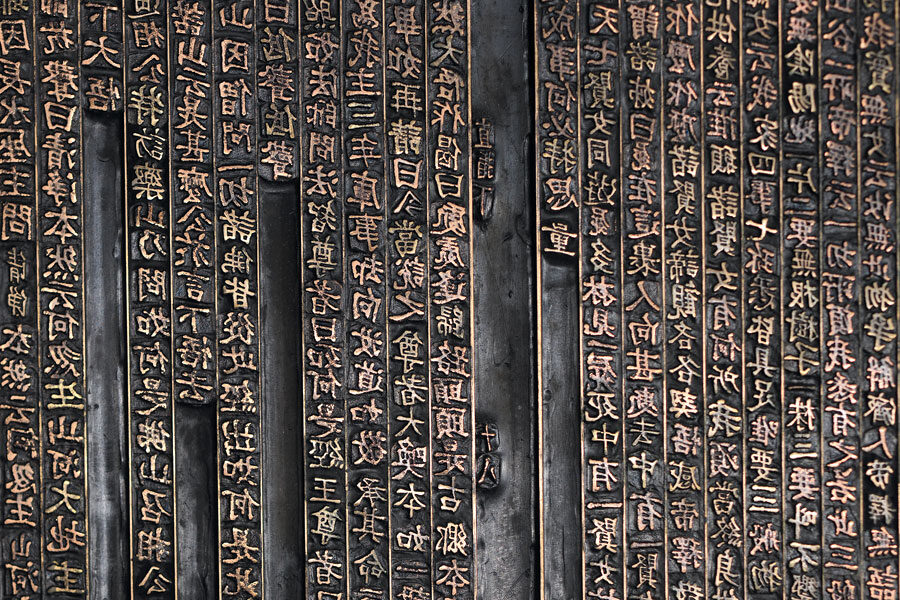
A Chinese person would be surprised if you tried to convince them that Johannes Gutenberg invented printing in Germany around 550 years ago.
In fact, the art of printing is much older, having been developed in East Asia, and centuries before Gutenberg's birth around 1400, the Chinese were already familiar with the system of "movable type."
Characters on bones, bronzes, ceramics, and stone steles prove that writing was already in use in China in the 5th millennium BC. Writing became reproducible in large quantities when the Chinese succeeded in inventing paper around 2200 years ago. Initially, it was made from hemp fibers, then from silk rags or mulberry bark and similarly exotic raw materials. But it worked: suddenly, large writing surfaces were available that could be easily produced.
Soon, the question of the reproducibility of characters arose. Chinese rubbing and copies of stone inscriptions, which enabled
the targeted distribution of texts, are now considered the precursors of printing.
In the 2nd century AD, at around the same time that the Roman emperor Marcus Aurelius was recording his philosophical thoughts on papyrus scrolls in the Western world and relying on scribes to reproduce them, the main works of classical Chinese literature were being carved into stone slabs in China over a period of eight years, starting in 175 AD. Thousands of copies were made in the form of rubbing: moistened paper was pressed onto the inscribed stones so that when the paper was brushed with ink, the carved characters stood out in white against the otherwise blackened paper.
The next stage was reached with the so-called woodblock printing in the 7th century: each character was carved upside down into a wooden block by removing all the surrounding wood. This created raised lines which, when colored and rubbed onto paper, transferred the desired text in positive form.
This high-pressure process, from a technical point of view, remained the printing technique used in China for centuries for religious and secular books, playing cards, calendars, paper money, and picture prints.
The sophisticated Chinese administrative and educational system of the Song Dynasty (960–1269) led to a golden age of book printing. Encyclopedias, manuals, and literary collections of all kinds were produced. Even at the end of the 19th century, woodblock printing was still in use in China.
But as early as 1040, when William the Conqueror was still spending his childhood in Normandy, a Chinese man named Bi Sheng was experimenting with movable, individually manufactured ceramic printing stamps. He arranged them on an iron mold to form entire texts and fixed them in place with a layer of wax and resin. Then he printed. If the characters were to be used again, the iron plate was heated until the melting wax and resin released the molds. Three hundred years later, the first wooden letters appeared.
From there, it was only a small step to producing individual wooden letters of the same size so that they could always be assembled in standardized blocks. Soon, successful experiments were being conducted with letters made of copper, lead, or brass.
However, printing with movable type remained a niche production in Asia until the end of the 19th century, never able to compete with woodblock printing. The reason was obvious: traditional printing with entire wooden plates required enormous storage space, but the thousands upon thousands of Chinese characters prevented the simple and, above all, quick assembly of printing plates from movable type. Attempts were made to optimize this process, for example by using a rotating sorting plate that was supposed to allow faster access to the characters. Nevertheless, woodblock printing remained the significantly more effective means of reproduction.
How much easier it was for Gutenberg to form all words with 26 letters and a handful of auxiliary characters!
In Asia, only the Koreans managed to take the decisive step: almost simultaneously with Gutenberg's invention, they developed an alphabetical script called "Han'gul," which initially comprised 28 characters, later reduced to 24. However, this had little impact on printing with movable type, as it was not possible to simply produce 24 characters and place them one after the other. Instead, they were combined to form letters. For example, if you want to write the characters ㄱ, ㅏ, ㄴ together, you don't write 가ㄴ consecutively as in the Latin script, but 간. The letters can be combined in many different ways (above and below each other, to the right or left). The letters even change their shape, making it almost impossible to create individual characters and simply put them together. Therefore, the ancient Koreans created the composite letters as a whole. Currently, Korean has 11,172 Unicode numbers, and in the Old Korean alphabet, as many as 1,638,750 combinations are possible.
This script was officially introduced in Korea in 1444 – almost at the same time, namely from 1452 to 1455, Gutenberg printed his famous Bible in Mainz.
Team "Mainz. Gutenberg 2000"