
Planting and caring for trees
If you missed the time in the fall, you can still plant a tree in your home garden in early spring. Our environmental tip provides tips on planting and caring for trees.
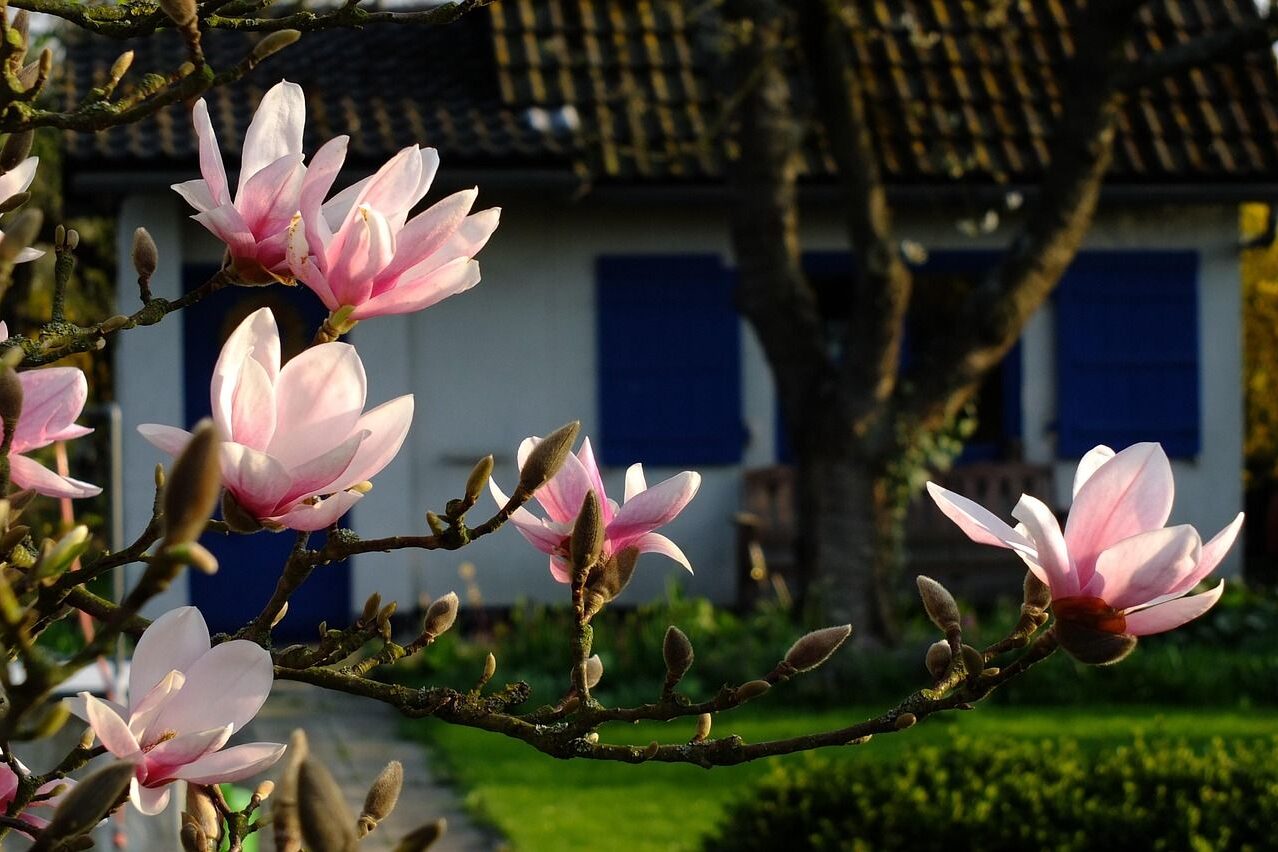
Before you plant your tree ...
People often underestimate the fact that trees have a long lifespan and can grow to an impressive size. That's why it's important to think carefully before buying a tree for your garden and to choose a suitable location for it. The roots in particular—which are invisible and grow underground—can grow to enormous proportions and literally cut off the water supply to other plants or damage nearby sewage pipes. Distances from the property boundary must also be observed. The regulations for this may vary from region to region. The City of Mainz's greening and design regulations serve to protect the climate and improve the urban climate. They primarily apply to new construction projects, but also have an effect on older existing buildings in the event of significant changes or redesigns of outdoor facilities. You can find more information on this in the list of links.
Consider how tall and wide the tree may grow. What is the soil like, sandy or loamy? Also pay attention to the light conditions. Some trees tolerate sun or shade better than others. Could the tree block the view from a window or take away light where it is desired at its potential location? Would you prefer a tree that bears fruit or provides shade? Other deciding factors may include the color of the leaves in autumn or evergreen foliage.
When buying a tree, a distinction is made between bare-root and potted trees. Bare-root trees are delivered without soil on the roots. They are usually cheaper and easier to handle due to their lower weight (they require a smaller planting hole). Until they can be planted as soon as possible, the roots must be protected from drying out (by covering them with soil) and frost. Potted trees are more expensive and heavier, but can be planted at a later date.
The right time makes all the difference
The right time to plant your tree is outside of the growing season, i.e., in fall or early spring. As a general rule, you should take advantage of frost-free days when the ground has thawed. Depending on the location, climate zone, or specific tree species, either fall or spring planting may be more suitable. Frost-resistant fruit trees such as apple, pear, plum, damson, mirabelle, and cherry can be planted in autumn without any problems. For areas with mild winters and dry summers, autumn planting is generally recommended. This is because winter rainfall is better utilized here, as the young trees already form sufficient roots in autumn and can store enough moisture.
Spring planting is recommended for all frost-sensitive trees, such as apricot or peach. If you plant in spring, you must ensure a good water supply, so the care requirements are slightly higher than for autumn planting. Planting too late can delay budding.
Which woody plants are suitable for your garden?
Whether you plant conifers, deciduous trees, stone fruit, berry bushes, or pome fruit depends on your taste and local conditions. Consider planting native species such as elderberry, rock pear, or mountain ash, as these offer advantages. They are less demanding, more resilient, and provide food and nesting opportunities for native insects and other animal species. Here, too, there is a wide range of options, from old apple varieties to oak trees. You can find more information on this in our list of links below.
When it comes to fruit trees, you can choose between different growth forms depending on the type of use and size of your garden. The so-called spindle bush, with a life expectancy of 15-20 years, is particularly suitable for small gardens due to its small size. These trees only grow to a height of about two to three meters, with a trunk height of maximum 60 centimeters. The low tree height makes maintenance and harvesting easier. Half-standard trees have trunk heights of 100 to 120 centimeters and grow to a height of about four to five meters. Standard trees grow even taller, reaching around six meters, and have a trunk height of 160 to 180 centimeters. Although these trees have a longer life expectancy, they usually only reach their full yield after about five years.
How to plant your tree
Proper planting can be crucial for the further development and future growth of your tree.
Digging the planting hole: Make sure it is deep and wide enough for the roots to spread out well. If the soil conditions are unfavorable, it is advisable to make the planting hole a little larger so that you can improve the soil around the roots with plenty of good compost.
Drive in a tree stake: Drive a wooden stake into the ground on the side of the planting hole where the wind usually blows from. The stake should reach up to the crown, but not protrude into it, to prevent chafing. The distance to the tree is approx. 10 cm.
Pre-treating the roots: For bare-root trees, trim the roots slightly with a knife or sharp shears. Remove any damaged or rotten roots. The fine roots are most important for growth. Do not remove these under any circumstances. If you have problems with voles in your garden, fruit trees with weak root systems (the technical term is "rootstock") should be protected from voles.
Planting the tree: It is better to plant the tree too high than too low, as it will settle later. In nature, trees also stand elevated and never deepened. The correct planting level has a decisive effect on the growth of the tree. If present, the grafting point (knot-like thickening on the trunk) should be approx. 10 cm above the ground. It must not be covered with soil, as otherwise the grafted part may form its own roots and the desired effect of the rootstock (e.g., dwarf growth) will be lost. When filling the planting hole with soil, shake the trunk slightly and pull it upwards so that the soil settles and all cavities are filled. Use the excess soil to form a wall around the planting hole. Finally, press the soil around the tree down slightly with your feet and water generously.
Tying and protection against browsing: A double-layered natural fiber rope in a figure-eight loop prevents the tree from rubbing against the post, swaying in the wind, and tearing off the fine roots. If there is a risk of browsing by animals, place a protective sleeve made of chicken wire, the "wire pants," around the trunk. Tip: Do not use plastic collars, as moisture will accumulate on the trunk underneath them.
Tips for tree care
Young trees should be watered intensively about once or twice a week for the first two to three years after planting, especially during dry and hot periods. The aim is to water infrequently but thoroughly (approx. 50–150 liters per watering) to encourage the roots to grow deep. As the trunk circumference grows, check the fastening rope once a year to ensure that it is not constricting the trunk. Keep the tree pit open so that grass and competitive perennials do not grow up to the trunk. Cover the soil with compost and mulch. Dried grass clippings, potting soil, bark humus, chopped clippings, or finely chopped nettles are suitable for this purpose. Only fruit trees require regular pruning in the first few years to ensure proper fruit set and crown formation. Young ornamental trees can be shaped by pruning.
Further information
Contact us
Address
Environmental store
Mainzer Umweltladen
Steingasse 3
55116 Mainz