Mobile stations

Sometimes it's quite simple: cycle to the streetcar stop, then take the streetcar into the city center. Mobility has become more flexible and more and more people are using several means of transport for one journey. There are mobile stations in Mainz to ensure that the individual routes fit together well.
What is a mobile station?
Mobility hubs are designated locations where various modes of transportation and mobility services converge—making it as easy as possible to switch between them. Depending on the location, you’ll find, for example: buses, streetcars, bike racks, bike-sharing stations, car-sharing stations, and electric car charging stations.
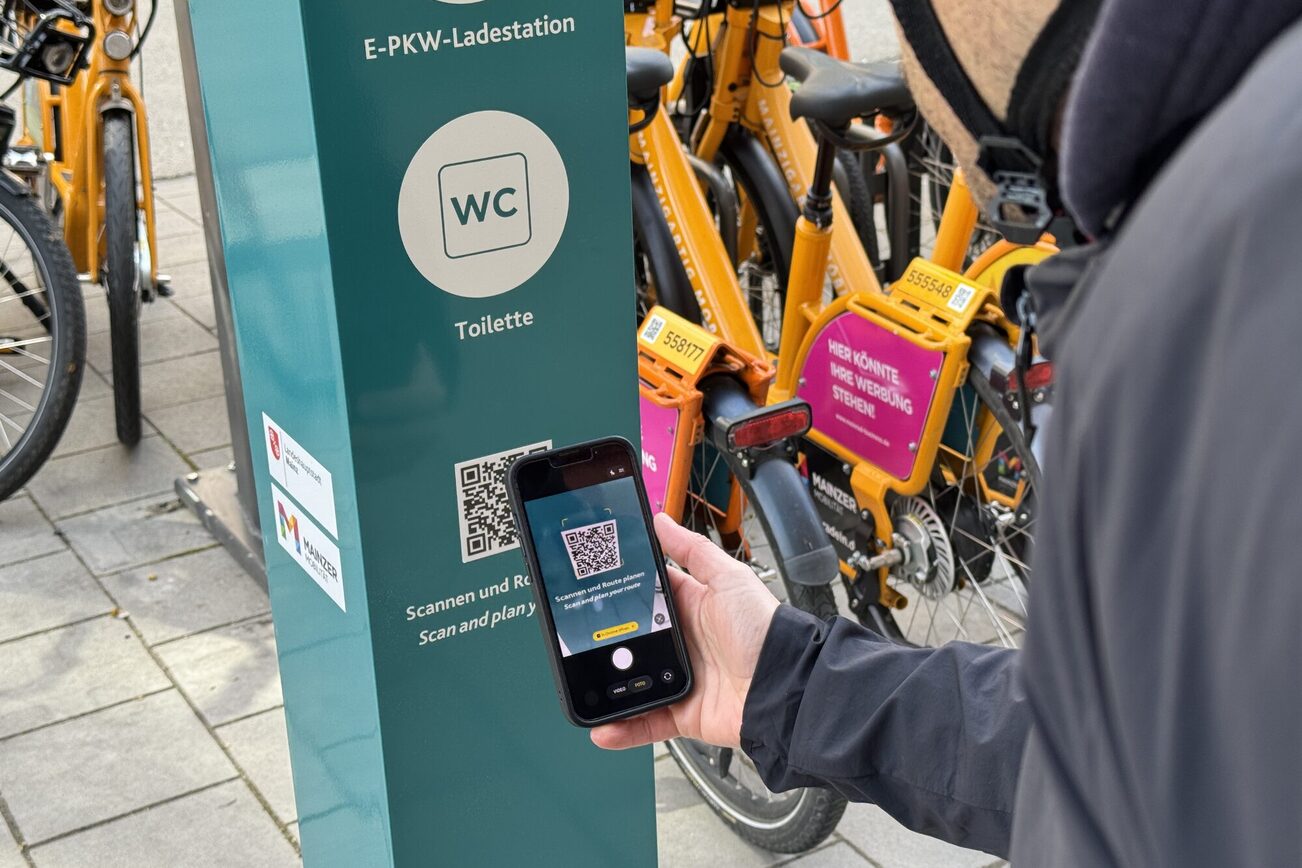
Here’s how to recognize a mobility hub: The three-meter-tall azure-blue pillar is your landmark. It immediately shows you which options are available on-site. At each Mobilstation, you’ll find a unique QR code on the stele—scan it to open the Mainzer Mobilität mobility planner, which provides an overview of the station and direct navigation. Mobilstationen are intended to establish themselves in Mainz as a visible symbol and brand for promoting climate-friendly mobility.
“Mobility in Mainz should be straightforward and practical for everyday use. With the mobility hubs, we’re bringing together different transportation options in one place and making it easier to switch modes. This makes mobility easier to plan and more convenient for everyone. Mobility hubs are a visible symbol of the mobility transition in Mainz.”
Janina Steinkrüger, Head of the Mobility Department
More and more bike-sharing stations are gradually being set up in Mainz. The map shows you at a glance where these stations are already in operation and where they are currently being installed. Green markers indicate stations that have already been installed, while yellow markers indicate stations currently under construction.
To view external content, you must open it by clicking on the "Share external content" button. When you do so, the provider sets cookies and collects data about your usage behavior. You can revoke your consent at any time in the privacy settings at www.mainz.de/datenschutz (opens in a new tab).
Mobile stations make everyday life easier:
- Visibility: Find transportation options faster.
- Flexibility: Easily switch between different options.
- Order: Designated spots for shared mobility options keep sidewalks clear.
- Climate protection: Making sustainable mobility easier in everyday life.
Background and resolutions
The establishment of mobility stations is part of Mainz’s climate protection strategy. The “100% Climate Protection Master Plan” (2017) and the Greencity Master Plan M³ (2018) had already defined the integration of climate-friendly transportation modes as a goal. In these plans, mobility stations were explicitly proposed as a measure to ensure optimal integration of transportation modes at key hubs.
In the spring of 2024, the City Council approved the development of the concept, and in the fall of 2025, the Mobility Committee approved its phased implementation. The first mobility stations were installed in late 2025 / early 2026.
In numerous other cities as well, mobility stations play a key role in making transfers between various eco-friendly transportation options straightforward and convenient, thereby making it easier for people to forgo using their own cars. They bring these services together in one location to form a visible, attractive, and user-friendly overall offering and, as a social gathering place, provide a high quality of experience. This also includes taking into account the needs of people with limited mobility.
The mobility stations are operated by Mainzer Mobilität in cooperation with the State Capital of Mainz. An internal city working group comprising representatives from the transportation administration, urban landscape management, and Mainzer Mobilität is continuously identifying additional suitable locations.

Further information
- Mainzer Mobilität/Mobility Stations (opens in a new tab)
Here you'll find more information about the mobile stations, an overview of the stations, current locations, and the mobility planner from Mainzer Mobilität.
- Flyer with information on mobile stations in MainzPDF-File1,47 MB
Flyer about mobile stations