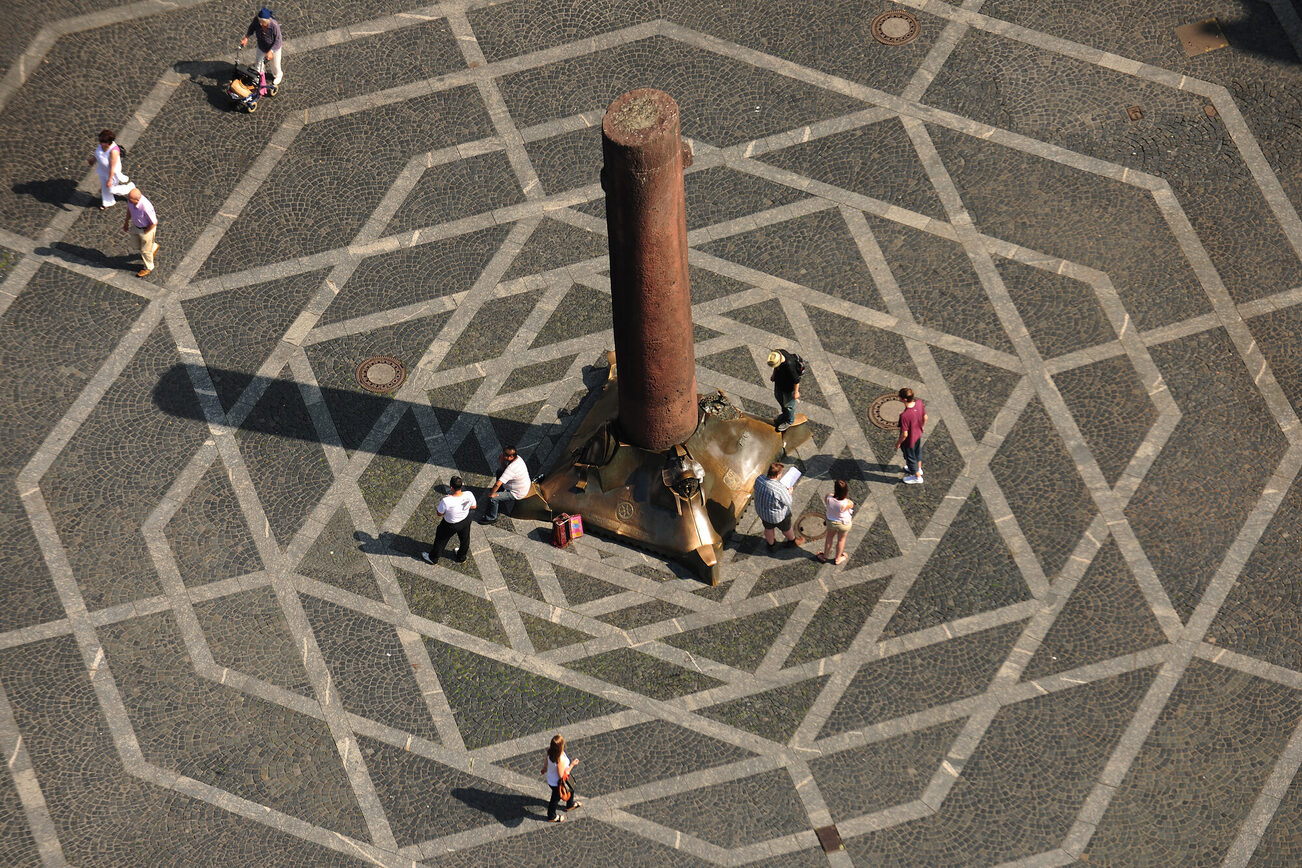
With its bronze cladding, the Heunensäule also tells many stories from the city's history.
One example is the headgear at all four corners of the monument:
- The replica helmet of a Roman legionnaire commemorates the establishment of the legionary camp in 13 BC and thus the Roman origins of Mainz. If you look closely, you can see a fox inside: it represents Jockel Fuchs, the mayor at the time the monument was built, while the mice behind him symbolize the three parties represented on the city council during the construction phase.
- The bishop's mitre symbolizes the Archbishop of Mainz, who shaped the city's history as its ruler. He had special rights over the other bishops in the Holy Roman Empire. As Imperial Archchancellor, he was also the second most important man after the Emperor. The mitre features casts of the seals of selected archbishops of Mainz, including that of Willigis.
- The jester's cap symbolically originates from a Jacobin cap, as worn by the French revolutionaries – a tribute to the "Mainz Republic"
of 1793 ...
- The imperial crown reflects the central position of the Archbishop and Elector of Mainz in the election of the Roman-German king. Several kings were even crowned in Mainz, including Frederick II of Hohenstaufen in 1212.
In addition to the depictions of the headdress, other details attest to the city's importance throughout the millennia: casts of Roman coins, the medieval city seal, and the early modern seal of the city court. Of course, the Mainz wheel in its various historical forms is also a must.
Two reliefs on the side facing the market houses refer to two particularly dark chapters in the city's history. The burning "Magenza" under the Star of David is a reference to the pogroms that repeatedly destroyed the once flourishing Jewish community of Mainz, most recently the extermination under Nazi rule. Next to it is an image showing the city after the destruction wrought by World War II, unleashed by the Nazi regime.