Background information
What has happened so far

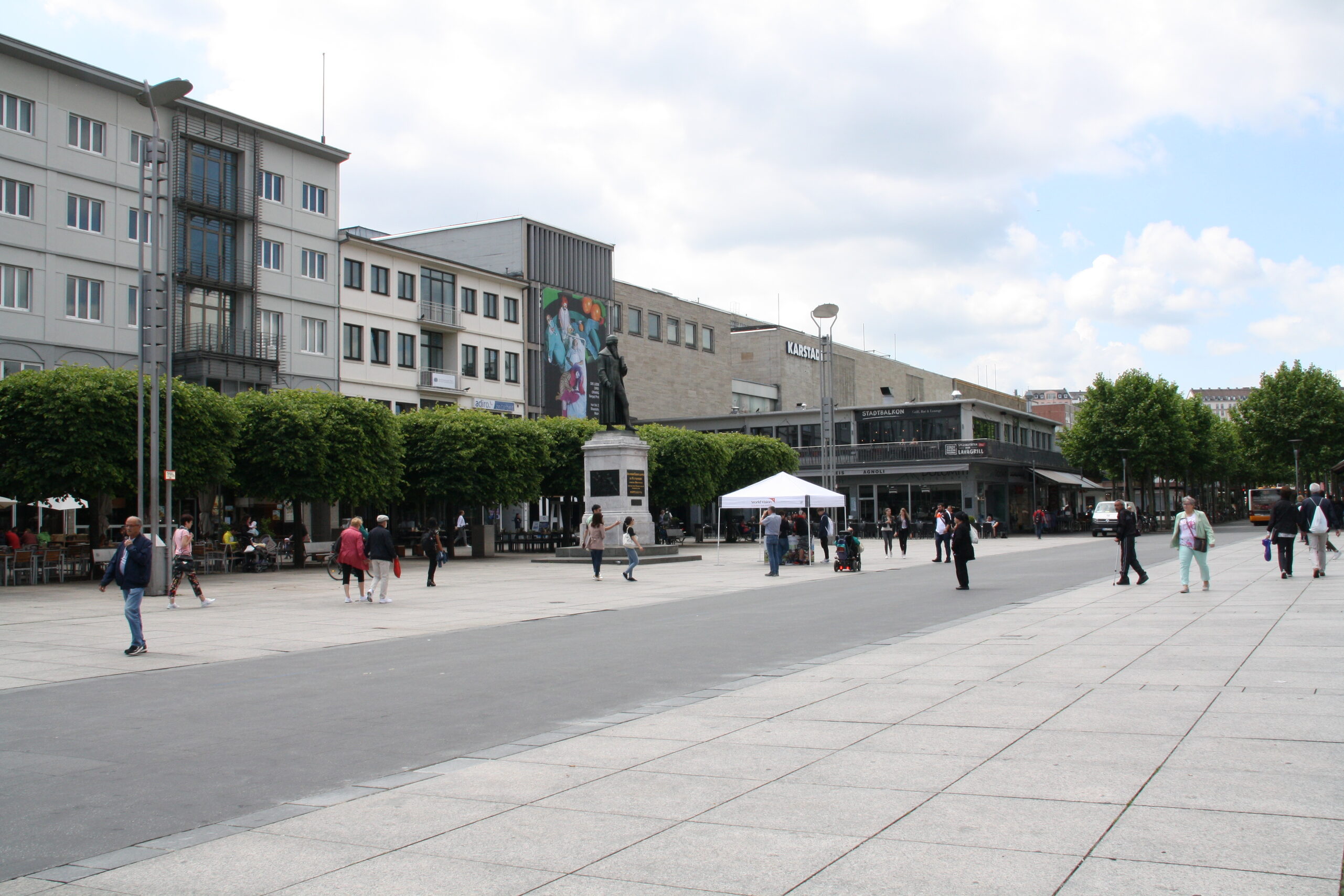
The striking five-story building with its protruding pavilions was constructed during the reconstruction period after World War II. Efforts to reorganize the urban landscape began early on. Two urban planning ideas and implementation competitions were held (1992, 1996). However, these were not implemented due to widespread criticism. Since then, the cost of renovation and modernization has grown.

In order to manage spatial, functional, and design development and involve the public in the process, the state capital of Mainz initiated the Ludwigsstraße Forums (LuFos) between 2011 and 2013. Here, citizens, residents, political representatives, and other stakeholders worked together in eight forums to reach a consensus on the urban development of Ludwigsstraße. The results were compiled in a final report containing guidelines and recommendations for future development, which was unanimously approved by the city council.

While the process was initially undertaken with ECE Projektmanagement G.m.b.H. & Co. KG, Boulevard Lu GmbH & Co. KG took over the lead in project development at the beginning of 2016. The company has set itself the goal of preserving parts of the existing building stock, such as the parking garage and the Deutsche Bank building. An initial framework plan was approved by the city council in 2017.

This framework plan has now been optimized in line with numerous suggestions and offers a number of improvements: in addition to preserving the existing structure, the framework plan aims to open up the building towards Ludwigsstraße more than previously planned and to retain existing public open spaces as far as possible. A spacious market hall and roof terraces complement the open space on offer. In April 2019, the city council took note of the revised framework plan and commissioned the initiation of public participation and further steps such as the announcement of competitions, the creation of building rights, etc. Public participation was already part of the guidelines developed within the framework of the LuFos.
What happens next?
The next step is to prepare the details of the project. The first task is to prepare the competition. Requirements for urban quality (urban development, facades, open spaces, etc.) must be defined for the competition. At the same time, the urban land-use planning process will be initiated. Due to the great importance of the Ludwigsstraße shopping district for the city center, the public will be involved at various stages of the overall process:
- Two public events prior to the competition to provide information on the current planning status and prepare the content of the competition announcement
- Involvement of citizens in the competition process
- Involvement of citizens in the urban land-use planning process