House at the synagogue Mainz-Weisenau
The area around the Weisenau synagogue is to be redesigned. Three ideas from a competition among architecture students were awarded prizes in March 2019 and provide material for an initial public discussion.
The synagogue in Mainz-Weisenau, dating from the 18th century, is the only synagogue in Mainz to have survived the Nazi era and the bombing raids, and is the oldest surviving building in Weisenau.
Special places that give the city its identity must be preserved.
At the beginning of 2019, the Friends of the Mainz-Weisenau Synagogue Association and the state capital of Mainz, together with the Architecture Department of Mainz University of Applied Sciences under the direction of Prof. Marc Grief, announced an ideas workshop for a "House at the Mainz-Weisenau Synagogue."
This ideas workshop heralds the first public discussion about the future development of the area. In a further step, an architectural competition will be held once the need and all building law issues have been clarified.
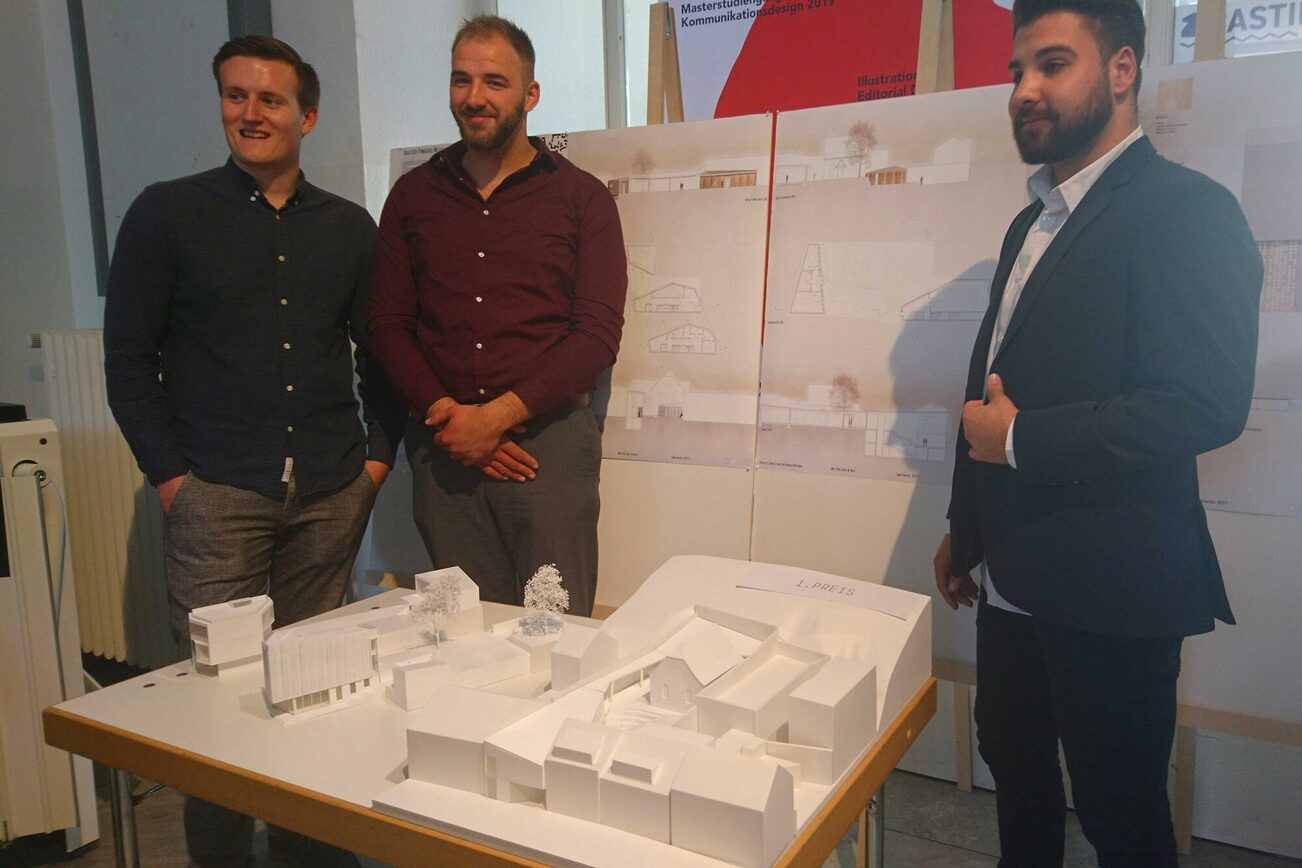
A jury comprising representatives of the city, the Chamber of Architects, and the Friends' Association selected the winners. The first three entries were honored at a ceremony in March 2019. An exhibition at Mainz University of Applied Sciences on Holzhofstraße presented and honored the work of all participants.
Assessment of the three prize-winning works
3rd prize: Marius Druyen
Mr. Druyen's design stands out thanks to its basic creative concept, which allows him to skillfully place the difficult boundary conditions of the property in an overall formal context. His polygonal layered planes respond equally to the synagogue and to the immediate neighbors. The shifting of the levels back and forth has a playful effect, although each shape has its own functional or design justification—sometimes as an entrance, sometimes as a link to the rear of neighboring buildings, or even as a prominent urban landmark in the line of Wormser Straße. Even the event hall at the rear of the property and the enclosure of the mikvah are integrated into this system, thus forming a recognizable ensemble.
Only the design of the façade does not fully deliver on the promise made by the building's structure: the window layout and color scheme lack a certain connection to the building project and the location. Nevertheless, Mr. Druyen's contribution, with its clever division of the interior spaces and very sensitive handling of the topography, offers a high degree of clarity and efficiency, thus making a valuable contribution to the discussion about this unique location.
2nd prize: Arne Müchler
Mr. Arne Müchler's design is impressive in its compactness, combining all functions in a single structure and thus offering the synagogue maximum free space. In addition, he succeeds in highlighting the special significance of the location in several ways: the asymmetrical shape of his roof and the protrusion of the façade from the line of the neighboring buildings announce the synagogue from a distance, and the separation of his building from the neighboring buildings to the northwest allows a view of the synagogue even before entering the grounds.
With its abstract copper-colored facade, the design stands out clearly from the surrounding buildings, thus reinforcing the significance of the location. Although the materiality of the outer skin is somewhat too prominent, the building as a whole creates an exciting design interaction with the synagogue, with attractive visual connections that could be further improved by optimizing the distribution of space.
Even if the potential of the spacious outdoor area is not always exploited, Mr. Müchler has nevertheless succeeded in strengthening the significance of the synagogue and its location and setting it in scene with a powerful gesture.
1st prize: Timor Faruqui
Timor Faruqui's design impresses with its sensitive treatment of both the synagogue and its immediate surroundings. The appropriately proportioned structures surround the synagogue at a respectful distance, placing it at the center of the overall complex. The polygonal shape of the structures creates a field of tension that not only creates attractive outdoor spaces, but also emphasizes the uniqueness of the synagogue and its future use without exceeding the scale of the surrounding buildings.
By reducing the design of the facade to a few elements and materials, Timor Faruqui emphasizes the sculptural treatment of his buildings, setting them apart from the surrounding residential development. His design is also impressive in its three-dimensional elaboration, offering spaces with diverse visual connections both inside and outside, thus subtly promoting communication within the community.
Overall, Mr. Faruqui has succeeded in creating a place with astonishingly simple means that not only restores the synagogue's representative status as a Jewish place of worship, but also protects it and thus creates an atmosphere of community.