
Environmental tip: The lapwing - bird of the year 2024
Environmental tip from the Mainzer Umweltladen
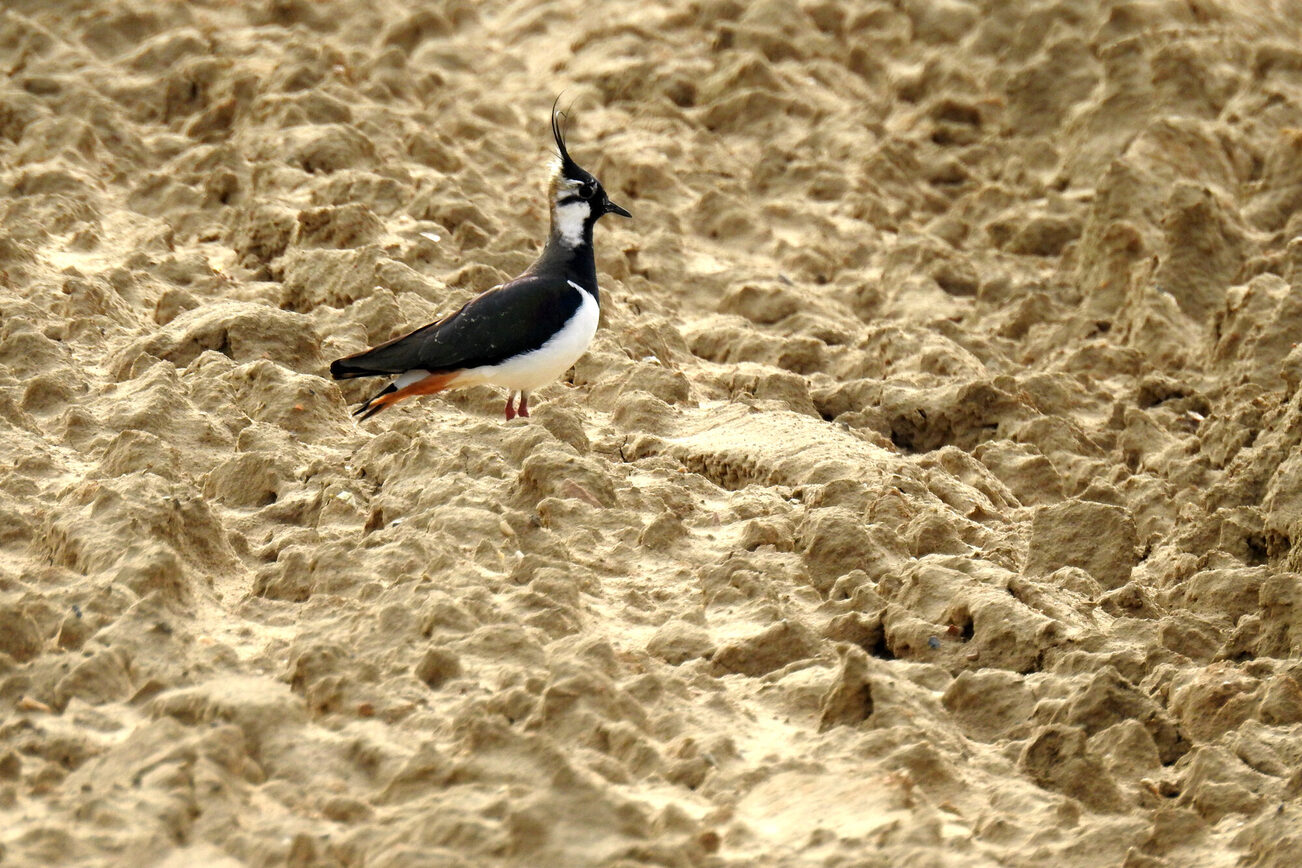
For the fourth time, the Nature and Biodiversity Conservation Union (NABU) called for a public vote. This time, the lapwing was chosen as Bird of the Year 2024. Just a few decades ago, the lapwing was considered a common bird in our region. But today it has disappeared from many places, with German populations declining by at least 93 percent since 1980 to only around 42,000 to 67,000 breeding pairs. The main reason for this is the loss of lapwing habitats.
Profile and behavior
The lapwing is a black and white plover about the size of a pigeon. It gets its name from its very distinctive call. Common calls are "kie-wit" as a contact call and "chä-chuit" and "wit-wit-wit-wit." On the sides of its white head, it has a characteristic black stripe below the eyes. Its plumage shines metallic green or purple in the light. A special feature of the lapwing is the erectile crest on its head. Males and females look very similar, but the male's typical "feather crest" is longer and the breast band is uniformly dark in color.
Males scratch small hollows in the ground and pluck grasses to convince females of their nest-building qualities with these so-called "dummy nests." At their breeding grounds, lapwings can often be observed performing conspicuous flight maneuvers. They circle above their territory, dive toward the ground in acrobatic flight maneuvers, and call out loudly. Their nest consists of a hollow in the ground and is surrounded by particularly short vegetation. Lapwings usually lay four eggs in it.
The lapwing has a varied diet, but mainly eats insects and their larvae. Earthworms, grains, and seeds and fruits from meadow plants can also serve as food.
Lapwings breeding in Germany are partial migrants. Some overwinter in Germany under mild weather conditions, while others migrate to wintering grounds in France, Spain, Great Britain, and the Netherlands. Other lapwings from eastern and northern regions overwinter on Germany's coasts.
Habitat and endangerment
Lapwings prefer areas with short vegetation without dense wooded structures or visual barriers nearby. Therefore, they were originally found mainly in moors and wet meadows. Today, lapwings have adapted to humans and the associated loss of habitat and also breed in fields and meadows. However, the drainage of wet meadows and more intensive agriculture have led to a massive decline in their populations. The lapwing has now disappeared from many agricultural landscapes. Drainage and the loss of wet meadows in particular are causing serious problems for the species. Early mowing and fast-growing crops make fields and meadows largely unsuitable as breeding habitats.
Added to this are ongoing land consumption, habitat fragmentation, and disturbances from human recreational activities. Many meadows and pastures are being drained, heavily fertilized, cultivated earlier and more frequently, or plowed up for fields. Where summer cereals were once grown, winter cereals are now grown in many places. However, these grow quickly, densely, and tall in the spring, so that lapwings often cannot find suitable breeding sites. Food shortages are another problem. For example, cornfields are attractive during the settlement phase, but later on, they hardly allow for breeding success due to a lack of food and cover. Insect food has also declined in grasslands. Finally, lapwings are exposed to numerous dangers on their migration to other areas. Since they may be hunted in several European countries, around half a million lapwings are killed each year.
Lapwings also have numerous natural predators. Their eggs are particularly vulnerable to predators, as they are easily accessible in open ground nests. Young birds that are not yet able to fly are also "easy prey." Mammals, especially red foxes, are mainly responsible for the loss of lapwing eggs. However, free-roaming dogs also disturb or endanger the brood.
In Rhineland-Palatinate, the lapwing is listed as a species threatened with extinction (RL 1) with a strongly negative trend, with only 100-200 breeding pairs remaining according to the state-wide Red List. The Society for Nature Conservation and Ornithology Rhineland-Palatinate (GNOR) is therefore developing and testing protective measures for the state's lapwing population in its "Aktion Grün" project, which has been running since 2021.
Watching lapwings - also in Mainz
The best place to observe lapwings is at their breeding grounds, where their flight maneuvers and frequent calls make them impossible to miss. In Germany, lapwings are mainly found in the northwestern lowlands, where there are still large numbers of meadows and pastures. During migration, lapwings can usually be spotted in large flocks in the sky thanks to their characteristic flight pattern. They also often rest on harvested grain fields.
In Mainz and the surrounding area, the Laubenheimer-Bodenheimer Ried is a good place to observe them. A total of eight breeding pairs nest here in the spring. Larger groups of lapwings also gather at this location in the fall. Before the lapwings return in mid-February, GNOR is inviting volunteers to take part in a biotope maintenance project in Mainz-Laubenheim on Saturday, February 3, 2024. For more information, please contact Gerardo Unger-Lafourcade from the lapwing project (see list of links below).
Further information
Contact us
Address
Environmental store
Mainzer Umweltladen
Steingasse 3
55116 Mainz