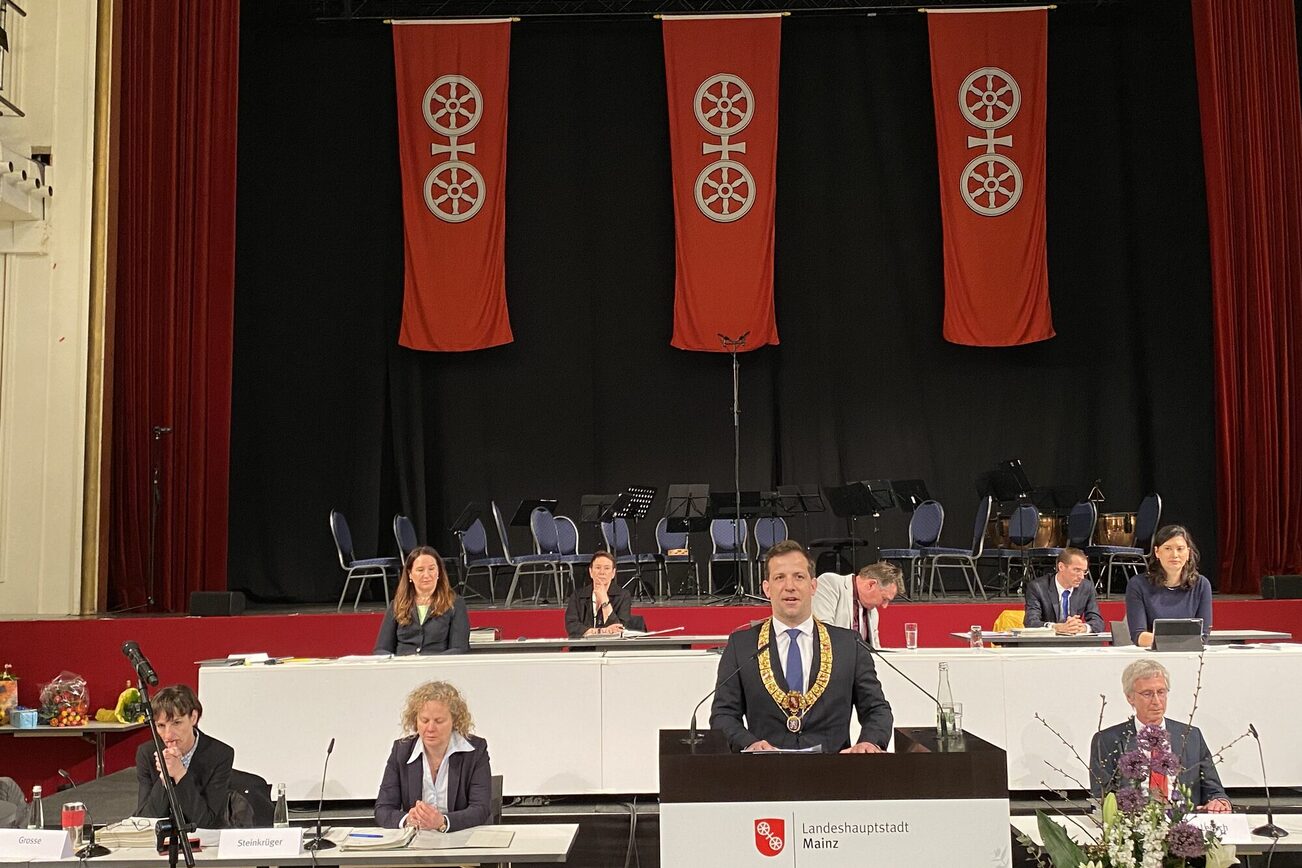
Inaugural speech by Lord Mayor Nino Haase
Wednesday, March 22, 2023
Location: Electoral Palace
Special session of the Mainz City Council
The spoken word shall prevail.
Dear members of Mainz City Council, dear citizens of Mainz, ladies and gentlemen,
"The secret to success is understanding others.
It's a question of the right chemistry."
And, as is often the case in the laboratory, this requires preparation, care, and time.
I am therefore particularly pleased to welcome Mayor Günter Beck. The past has brought us together through sporting activities at FC Vorwärts Orient. I am looking forward to the new constellation of cooperation – I am sure that we will now be talking much more about sports fields and facilities than we will actually be standing on them!
I would like to welcome our State Minister of the Interior, Michael Ebling: Your authentic manner and the energy you have shown over such a long period of office already give me a hopeful outlook on how fulfilling and valuable my role as mayor can be. I
would also like to once again expressly welcome our honorary citizens and my friend Margit Sponheimer.
I would like to welcome the local council leaders, the members of the local advisory councils, the advisory boards and committees, as well as the employees of the administration.
And now to those for whose welfare I am privileged to work, for whom we are privileged to work: Dear citizens of Mainz, thank you very much! Being elected with 63% of the vote shows me how confident and willing the citizens are to lay the foundation for a shared, bright future. I, for one, feel honored and at the same time challenged to become the best version of myself for our city.
This inauguration is a special occasion for our city of Mainz – but also, frankly, for my dear wife Mandy, my family, my friends, and ultimately for me as well. An event that touches me deeply—a very beautiful day in my life, and you can be sure that I am taking on this office with humility and gratitude, with great determination, but also with great respect for the magnitude of the task.
Dear city councilors, we have it in our hands together. Our task is called Mainz, and together we must ensure that our city becomes even more beautiful, even more climate-friendly, and above all, even more humane in the coming years. What makes this city special, what it can do, and what it should be in the future: the many dedicated people in administration, politics, and our urban society know this too.
But I want us to work together to make Mainz a place that attracts and inspires everyone: that everyone can imagine and afford to start a family here and plan their lives into old age. And that everyone is so enthusiastic about the positive image of our hometown that they want to work for Mainz, whether in a voluntary capacity or as a career with the city. This, and nothing less, must be our common goal.
I am convinced that this can only be achieved with the utmost mutual respect! You, dear representatives of the Mainz City Council, can always be assured of my appreciation, as can the many representatives present from the Advisory Board for Migration, the Women's Office, the Disability Advisory Board, the sports and carnival clubs, and the many other initiatives, and of my respect.
Despite all the political profiling, differentiation, and exaggeration that is necessary in a vibrant democracy, one thing must always be evident across all groups when it comes to crucial issues: "The right chemistry" will ensure the well-being of the city of Mainz – the mix must be well-balanced and proportionate. We must recognize and appreciate our positive qualities and then use them in a very targeted manner to enable development and protect prosperity and social security for people of all origins and backgrounds.
In this cosmopolitan spirit, I naturally want to not only take citizens seriously and actively involve them—I would very much like to work hand in hand with you, with all of you.
And sometimes the most obvious form of citizen participation is participation in all of our committees: in addition to the city council, our elected local advisory councils are a foundation of local democracy! This is where the seed of enthusiasm for local participation lies, and this is where the strength of local politics lies: communication at the smallest level outside of "big" politics. This must be taken seriously, in all our interests and with all the effort that this entails, if we want to work together to prevent destructive political elements from gaining further strength in the future.
Almost exactly five years ago, the first and so far only referendum in the history of the city of Mainz took place. With the subsequent Gutenberg Museum workshop, we as a city community gained valuable experience and developed a consensus that we are all happy with today. This was the impetus for more citizen participation in our city.
Today, we have the opportunity to take participation to a whole new level: the guidelines on citizen participation adopted last year. In Mainz Mobility, we have an experienced partner that has just launched a participation process for the tram expansion. And I am looking forward to the Government District Forum, which will begin discussing the design of the castle grounds in April. But I am particularly looking forward to the further expansion of youth participation. And I am delighted that, following intensive citizen participation, we are now taking the important final step in finalizing the central project for our city center, Ludwigsstraße. Here, we must now demonstrate how powerful participation is and how much value it can add to our city.
We must make our democracy tangible and experiential—for all age groups, but especially for the youngest. More democracy, more togetherness, more solidarity. That is our – typically Mainz – response to radicalization and indifference.
I look forward to productive, open, and trusting cooperation, in which we see ourselves as setting the pace together to make our city even more of a pacemaker for the entire region. On the one
hand, this means that we are living up to the equation: The stronger our city, the stronger the region!
And that is why I see all important investments in our city's future, whether publicly or privately financed, as investments in a sustainable and meaningful future for the region. Joint, reliable, sustainable mobility with the district and increased cooperation in the areas of housing and education are essential for our rapidly growing region. I would therefore like to strengthen or initiate inter-municipal cooperation with our surrounding communities in the future.
I said recently: Rheinhessen does not begin behind Ebersheim and Finthen. Rheinhessen begins right on the banks of the Rhine. And Mainz is the anchor of our region in the Rhine-Main area – not officially on the right bank of the Rhine, but we remain a bridgehead.
On the other hand, I am aware that we are continuing to build this city on the foundation laid by our predecessors. This foundation in Mainz is very stable, especially in today's world, thanks in part to biotechnological knowledge, and offers us a very reliable basis for moving forward with new ideas, while remaining conscious of our Mainz identity. Science, research, development – that is Mainz's DNA in the tradition of Gutenberg. The city must work more closely with its research institutions, become more internationally oriented, and make our knowledge visible in the city's architecture. This applies to both historical and current successes. Throughout history, Mainz has always been of supraregional importance: the expansion of the Gutenberg Museum must be just one important step toward a cultural and tourism strategy that is presented with a unified voice.
With the opening of LEIZA this Friday, further potential is opening up for historic Mainz – we have known for several years that we are the city of two cathedrals! I can highly recommend a visit to St. Johannis. I would like to bring these and other cultural treasures to fruition and make them known nationwide by the end of my term of office. Good
leadership is essential for our joint success. I would like to contribute to this by ensuring that joint projects can be carried out by healthy, committed, and satisfied people. My vision of leadership for the future is based above all on a willingness to cooperate. However, a good, modern leadership culture also includes genuine participation by our own employees. I would like to introduce permanent communication and efficient idea management even more clearly in our administration, in close coordination with the staff councils. Only with a healthy workforce that is listened to will we be able to shape our city for the future.
I want to and will be responsible for connecting people. Our strong city history provides us with a great deal of identification and energy across generations for the many challenges that lie ahead. And we can now tackle these challenges; we can now shape the future after decades of financial hardship. We all now bear responsibility for what is, to my knowledge, the greatest gift that has ever been given to a municipality in Germany. And from my own experience, I can tell you that dealing with great fortune and great gifts requires a lot of discipline and even more responsible foresight. This is not easy and will only succeed if we work together to develop this incredible opportunity: we must now, together with our housing association, create reliable homes with family-friendly and affordable living space.
We must develop our city in a future-proof manner: with modern digital working conditions and a high level of appreciation for our municipal workforce.
We can now combine sustainable economics and climate protection and keep Mainz livable for people of all ages.
Because we need people in our state capital: just to compensate for retirements and staff shortages in the city administration, we will need around 6,000 new employees by 2035. This affects us massively in the areas of municipal education and training facilities, administration in general, and many municipal tasks. It is a task that is essential for trust in our city. And I am convinced that you will all support me to the best of your ability in these areas of personnel recruitment, from internal measures to staff housing! The issues surrounding the shortage of skilled workers are affecting us Mainz residents more and more every day – but our Mainz identity is that we don't just brood, we prefer to take action.
I want to lead the way: With a city that presents itself professionally and positively on all relevant channels, both traditional and social media, showcasing its treasures and qualities, tackling the mammoth task of modern digital administration and becoming a pioneer in what people long for: that we show how effective we are as an administration and as politicians when we argue about the issues and focus on the well-being of Mainz. Do good and talk about it – that must be our approach in Mainz, and it will inspire people to join us in our city.
And do you know what is even better than taking advantage of this gift of the present, our financial leeway? Laying the foundations
now so that we can remain strong in the future and invest heavily in our social cohesion.
For me, investment in education and training is essential to ensure that the people of Mainz can look to the future with optimism in these times. To achieve this, we in Mainz must also set the pace here: language and education programs are not affordable for all municipalities after the coronavirus pandemic – but we should be able to afford them! The same applies to the revival of apprenticeship professions in collaboration with local partners such as the Chamber of Industry and Commerce or the Chamber of Crafts. For the future and our generational projects in biotechnology or the expansion of renewable energies, skilled workers in these areas are just as important as the connection to Johannes Gutenberg University or our Max Planck Institutes.
As the state capital, we should also afford to exert all our influence on the state. When we talk about local self-government, we must also be able to "govern ourselves." In many respects, this means adapting to the realities of life: Of course, we still have room for improvement in the areas of modern working methods, home offices, and flexible working hours, even internally in the administration.
But filling urgently needed planning positions in the building administration or hiring in the education sector cannot be adequately achieved at the border with Hesse and Wiesbaden with wage groups that already make it difficult in the more rural areas of Rhineland-Palatinate. We need to quickly agree on solutions with the state and the municipal employers' association.
Because if we want to build a reliable future, if we want to spread optimism about the future among young and old alike, if we want to keep Mainz livable and innovative with a holistic approach to urban development in line with our climate goals for 2035, we need this room for maneuver, we need the potential of well-educated people, and we must fight for it together.
As mayor, I will not be able to achieve this alone – and neither will you as city councilors. You and I, the ADMINISTRATION, the many people in VOLUNTARY POSITIONS, organized in associations and initiatives, have enormous expertise together. And we will be able to benefit from this. This will only work if we can appreciate each other. However, for this communication and coordination to work, we need modern digital equipment and the best working conditions throughout the city. Together with our
Digitalization Advisory Board, we must now quickly develop concepts that will enable us to work more efficiently as a city, relieve the burden on people in the administration, and make us a pioneer in the field of digital, collaborative working methods.
In addition, there are many committed people in all areas and great potential in science, business, culture, and sports. Through stronger cooperation, the right chemistry in debate, trust, and a genuine interest in people's needs, I want to harness our potential. "If you want to be involved in politics, you have to realize that you have to like people," said Bruno Kreisky, the long-serving Austrian chancellor. What sounds trivial sometimes requires courage and perseverance, conviction, and a great deal of idealism.
My goal is to be an approachable, non-partisan, convincing, and energetic mayor for the people of Mainz. I will use my commitment and determination to work with you over the next few years to make Mainz even more attractive, even more successful, and even more humane.
To this end, I extend my hand to all of you today and wish you all every success in our joint endeavors.
Thank you for your patient attention. Now it's finally time to get back to our normal work routine, where the right chemistry between us will be important—and as you know, I know a thing or two about chemistry...