Rhine bank design

The state capital of Mainz is gradually renovating and redesigning the inner-city banks of the Rhine in three currently planned construction phases. This is based on the recommendations of the Rheinuferforum, a workshop process, the results of which were approved by the city council.
You will find regular updates on the project on this website.
Information on the planning process
Planning for the Rhine riverfront is moving forward: the preliminary design was presented to city committees in the fall of 2025 and approved by the City Council on October 1, 2025.
The City Council instructed the administration to proceed with the Rhine riverbank redevelopment in phases and to secure funding. The City of Mainz’s application to have the “Rheinufer Innenstadt Nord” area—which encompasses the Rhine riverfront between the underground parking garage and Zollhafen as well as Feldbergplatz—included in the federal-state program “Growth and Sustainable Development – Sustainable City” was successful. The state will fund 90% of the project.
The necessary permits, such as building permits and water rights permits, are currently being obtained. The applications have already been submitted to the permitting authorities. The intention is to develop the implementation plans (detailing the plans to the point of construction readiness) and the scope of work in the course of 2026 in preparation for the tendering of construction services, so that work on the renovation of the first section can begin in the spring of 2027.
Our banks of the Rhine!
The Rhine riverfront in Mainz stretches over 16 km and borders the five districts of Mombach, Neustadt, Altstadt, Weisenau, and Laubenheim. The downtown riverfront, spanning 4.5 km, lies between the Kaiserbrücke and the Südbrücke.
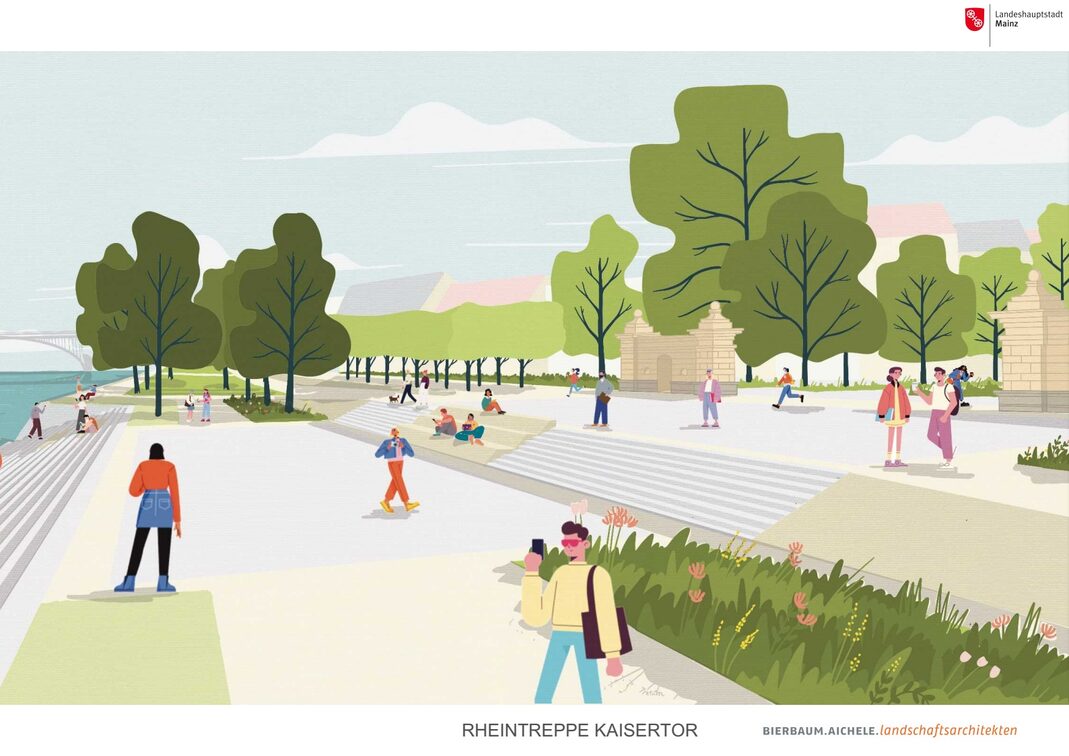
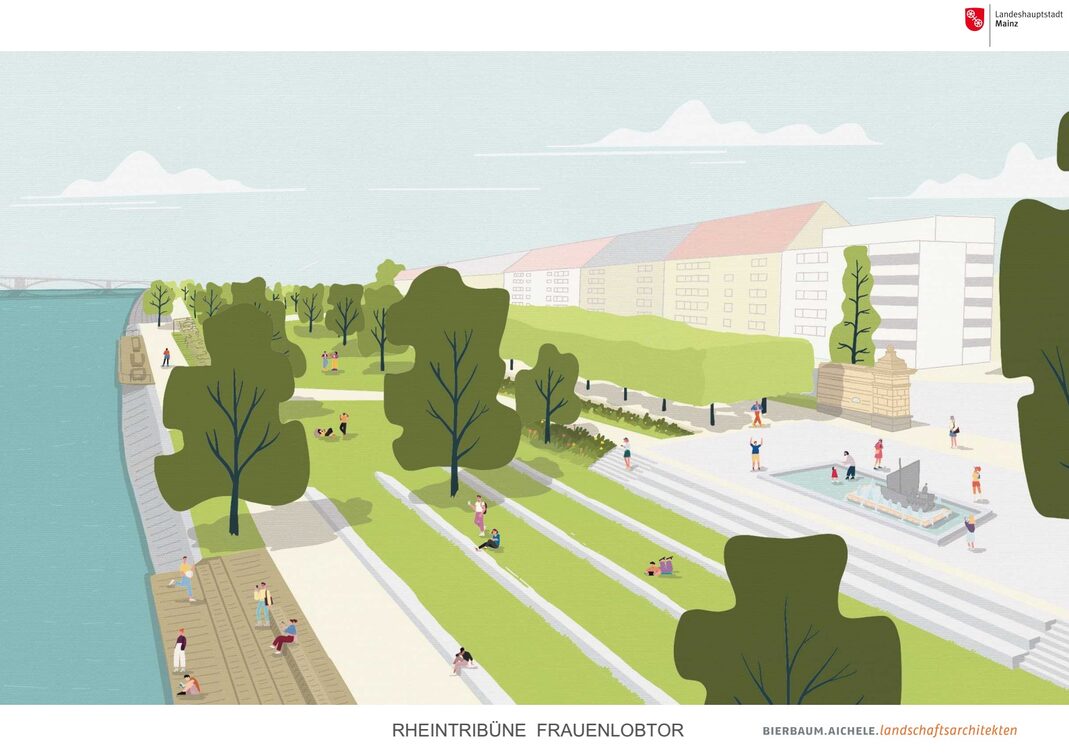
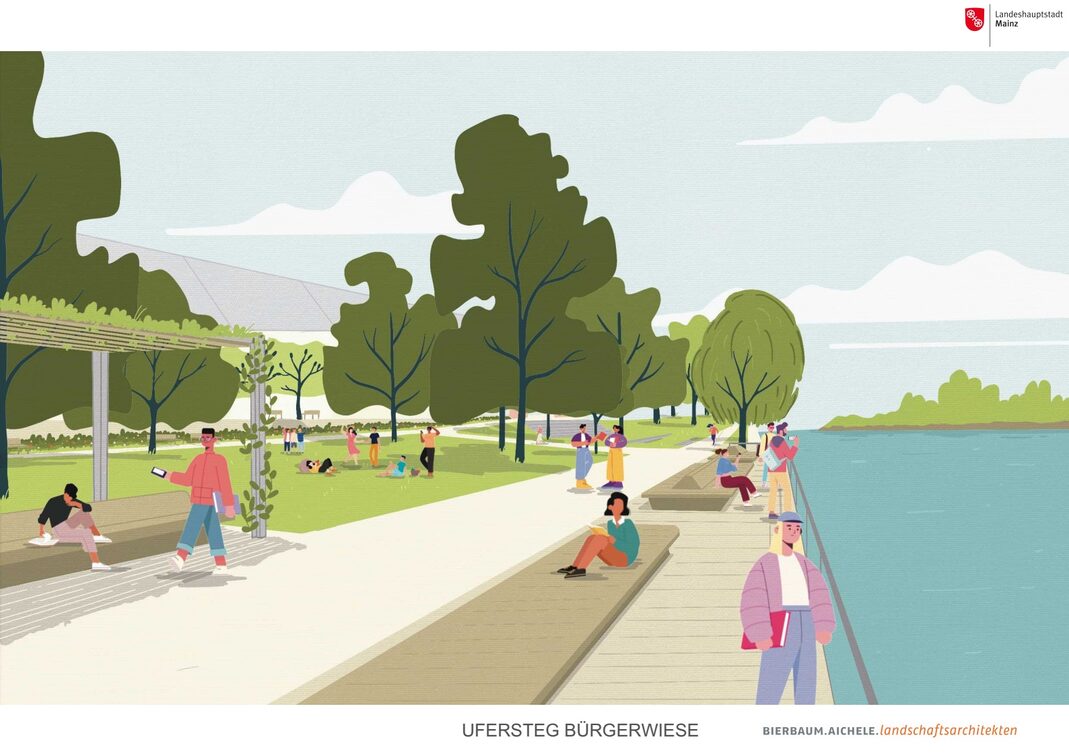
The concept divides the riverbank into three sections: an activity park at the Kaisertor with a wide variety of recreational sports and exercise options, a green riverside between Kaisertor and Caponniere featuring spacious, open-access lawns—some sloping down toward the Rhine—and attractive play facilities, as well as green spaces and areas for participatory uses and environmental education in the transition to the Zollhafen. Numerous seating areas, tree plantings, and several pergolas provide shaded spots, serve as anchor points for visitors to the riverbank, and enhance the overall experience. Large sections of the currently paved riverbank can be unpaved, and numerous trees can be planted.
Since the riverbank is too narrow to accommodate separate lanes for bicycle and pedestrian traffic, fast-moving bicycle traffic—such as commuters—will be routed along Taunusstraße in the future. The provision for fast-moving bicycle traffic on Taunusstraße can significantly reduce conflicts on the narrower pedestrian/bicycle paths.
The end of Kaiserstraße will be designed as a plaza, and the existing small-scale structures—the kiosk, restroom facilities, and transformer station—are to be reorganized within a cohesive building complex. Most of the key points from the requirements identified through public participation were thus incorporated into the planning.
The banks of the Rhine? Your bank!
The results of the public engagement events can be found further down the page. All interested residents of Mainz are encouraged to get actively involved and share their wishes, expectations, ideas, and comments regarding the Rhine riverfront so that the collaborative planning process can be a success.
Suggestions and questions can be sent to rheinuferstadt.mainzde.


The banks of the Rhine? Your bank! (1st phase of public participation)
Results - 1st phase of public participation
Results - 2nd phase of public participation
Why is the Caponniere not part of the "Rhine bank design" public participation program?
Further information
Contact us
Contact us
Address
Mr. Moritz Morsblech
Head of department (head of department for open space and object planning)
Grün- und Umweltamt, Haus C
Room26a
Geschwister-Scholl-Straße 4
55131 Mainz
Postal address
55028 Mainz