
Environmentally (un)friendly building materials
Waste generation and raw material consumption by building materials
The flooding disaster in Rhineland-Palatinate and North Rhine-Westphalia in July 2021 left behind vast amounts of construction waste, mud, and bulky waste. How to store, separate, dispose of, or recycle the partially contaminated debris poses major challenges for the states and municipalities involved. However, the situation also presents an opportunity to break new ground in the use of building materials and the furnishing of residential and commercial buildings.
Since we spend up to 90% of our lives indoors, there is a growing awareness that indoor air and the materials used should be free of pollutants. However, the actual building fabric is often problematic: hazardous to health, harmful to the environment in its production, or difficult to dispose of. According to the US Environmental Protection Agency, construction and demolition waste (including road construction waste) plays a key role in a closed-loop economy. In 2019, it accounted for the majority (55.4%) of gross waste generation, at around 230.9 million tons. According to United Nations estimates, the construction industry accounts for 50 percent of raw material consumption in Europe.
Asbestos and concrete
Asbestos is the classic example. Although this insulation material, once very popular due to its heat and acid resistance, was banned in Germany in the 1990s, many building materials containing asbestos can still be found in older houses. In buildings, asbestos was mainly used in the form of asbestos cement. A second example is concrete. When a structure needs to be stable and durable, construction companies turn to concrete. Concrete has been the key building material of the past 150 years. It has contributed to unprecedented social progress and prosperity.
The negative aspect of concrete is its environmentally harmful production. Concrete production accounts for 6 to 9 percent of man-made CO2 emissions. The actual construction is not even included in this calculation. Large quantities of greenhouse gases are released, primarily through the burning of cement required for concrete production. Materials such as the sand used for concrete are becoming increasingly scarce and expensive.
Building with a future - how does it work?
In most cases, we do not know exactly what materials were used in the buildings we rent or work in. It is only when demolition takes place that it becomes apparent that materials cannot be recycled because they are inseparably bonded or contaminated with pollutants. This raises the question of using environmentally friendly building materials as early as the planning stage. In view of the above-mentioned waste generation, it is important to consider what should happen to the building materials once they have served their purpose. Future-oriented construction requires thinking in terms of material cycles from the outset.
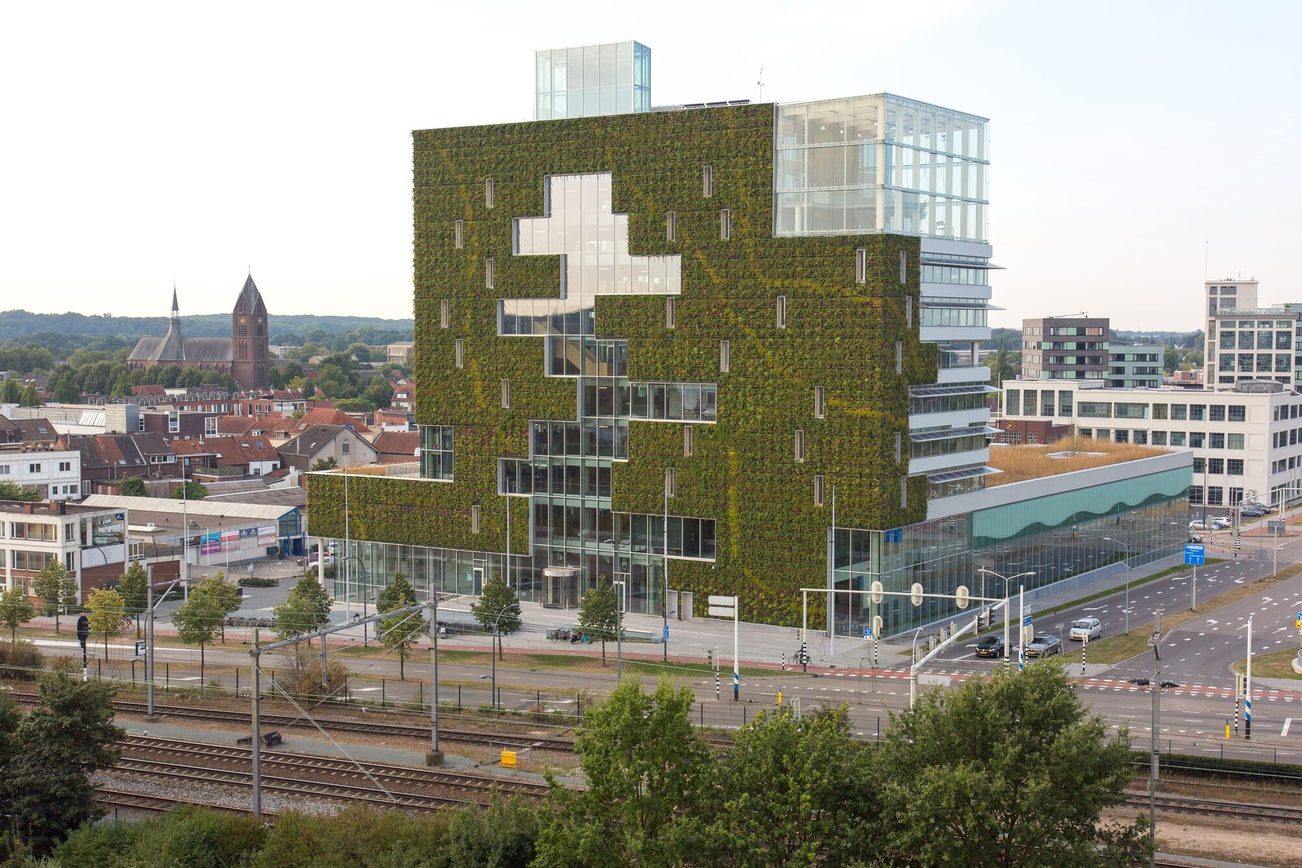
The Netherlands set an example back in 2007. The town hall in the municipality of Venlo is a special building because it was designed and built according to the principle of circular economy. There is no waste. All products and raw materials can be reused after use. It is currently being visited by architects and builders from near and far. It is considered proof that circular economy can be worthwhile, provided that the residual value of the building in terms of materials is taken into account in the calculation, see link to the video at the end of the article.
In Germany, the former Zollverein coal mine in Essen is a best practice example. Since 2017, it has been the administrative headquarters of RAG, formerly Ruhrkohle AG, which is now responsible for the consequences of coal mining. As a pilot project of the EU research project "Buildings as Material Banks," the idea of the circular economy is also being implemented in this building. For more information, see "Tips for environmentally friendly building and living" and the list of links, among other things.
Ideas were also implemented in the construction of the Environmental Education Center (UBZ) in Mainz and the new administration building of the waste disposal company to create buildings that will not be a burden on future generations. Only building materials and materials that are easy to dispose of were used. For example, recycled concrete was used and the insulation materials can be cleanly dismantled and reused.
Tips on environmentally friendly building and living
Overall, there is still much room for improvement in resource-efficient and waste-free construction. From the perspective of those seeking housing, the search for healthy and sustainable living space is also complex. Sustainable living only partially takes the building fabric into account. It also considers quality of life, ecological, energy, and economic aspects. The Federal Ministry of Transport, Building, and Urban Development has set up a working group on sustainable housing. This has resulted in the Association for the Promotion of Sustainability in Housing, or NaWoh for short, which certifies sustainable housing (see link list).
The EU research project "Buildings as Material Banks" (BAMB) aims to put a stop to the immense consumption of raw materials and waste generation in the construction industry. Until now, at the end of a building's life cycle, valuable materials were either recycled in a substandard manner or ended up in landfill. With the material passport that has been developed, there is no more waste. It helps to integrate recyclable building materials into the planning stage, to process them after demolition, and to reuse them in the same quality. The material passport thus creates the transparency that is necessary to realize a circular economy in the real estate sector. In addition, it documents which manufacturer the product or raw material comes from. See below for more information.
Cardboard (Wikkelhouses on Heligoland), straw, and clay are being discussed as alternative building materials.
Even plastic, which is not a biological building material, becomes a sustainable option in house construction through re- and upcycling. And this is done in an extremely mundane, almost bizarre way: filled with rubble and sand, the plastic bottles are stacked on top of each other, stabilized with nylon cords, and plastered. Concrete is also used in some cases, but large quantities of this environmentally harmful building material can be saved. In Honduras, where plastic bottles have been used in house construction for years, these "bottle houses" have already proven to be particularly stable. They can withstand earthquakes measuring 7 or higher on the Richter scale.
Wood is considered the building material of the future. Its sustainable production, material properties, workability, cost-effectiveness, safety, and living environment are cited as arguments in its favor.
Hemp concrete is made from fibers of the hemp plant mixed with lime. Once hardened, the material, also known as hemp lime, is slightly lighter than actual concrete and significantly more flexible. It is flame-resistant, stores heat, and absorbs noise.
Steel is one of the few materials that offers a 100 percent closed recycling loop. This means that steel can be used efficiently over and over again without losing its properties or performance characteristics—and without producing harmful waste products.
Further information:
- Lighthouse project: Venlo City Hall, Netherlands (opens in a new tab)
- RAG Zollverein, Essen (opens in a new tab)
- EU research project Building as Material Banks (opens in a new tab)
- Association for the promotion of sustainability in housing construction (opens in a new tab)
- Alternative building materials (opens in a new tab)
Contact us
Address
Environmental store
Mainzer Umweltladen
Steingasse 3
55116 Mainz