
Environmental tip: Deadwood habitat
Environmental tip from the Mainzer Umweltladen
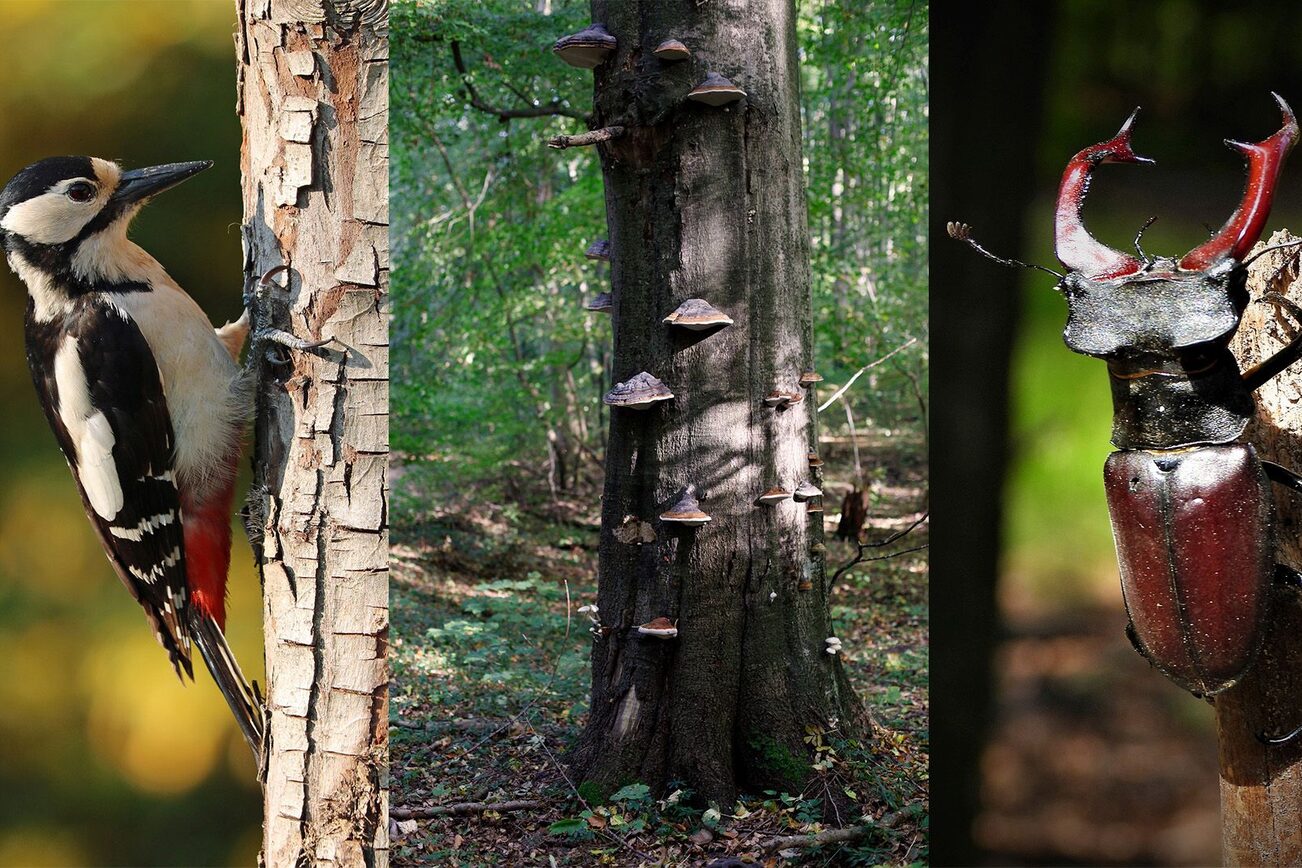
Deadwood is pulsating with life. Hardly any other habitat offers such structural diversity in such a small space and produces such a wide variety of species. Deadwood is the stuff of biodiversity, as an estimated 8,000 plants, animals, and fungi depend on it.
Endangered habitat
For centuries, wood has been an important source of energy and building material. Forests were intensively exploited and deadwood was rarely left in the forest. In commercial forests, trees do not reach their natural age, which is associated with a high proportion of deadwood, but are harvested earlier. Recently, however, efforts to promote deadwood have once again been met with significant opposition. With the scarcity of fossil fuels such as oil and natural gas, wood is regaining importance as a CO2-neutral energy source. Even wood that until recently could hardly be used profitably and remained in the forest is now in demand as a raw material. This could seriously endanger many specialized species.
Highly specialized
We are talking about "xylobiont" species. These are organisms that live in wood, feed entirely or partially on wood, depend entirely or during certain stages of their development on dead wood, or use the cellulose contained in wood to build their nests.
Most species living in dead wood are fungi and insects, especially beetles and hymenoptera. Among the insects, these are species that feed directly on bark or wood, such as longhorn beetles. On the other hand, there are insects that, as secondary colonizers, use the cavities and tunnels created by wood-eating insects for their own breeding without feeding on the wood substrate itself. These include, for example, some wild bee species. Various fly and mosquito larvae graze on the fungi and bacteria growing in the tunnels or feed on mulm (wood that has decomposed into substrate), dead material, and insect feces. In addition, many predatory and parasitic insects specialize in feeding on the animals living in the wood.
Deadwood formation, characteristics and inhabitants
The natural decomposition of a tree is individual and takes decades to centuries. When deadwood is formed, all parties involved contribute to the energy and nutrients stored in the wood being released more quickly and made available to the forest again. The conditions on and in the immediate vicinity of deadwood are favorable for seedlings. Deadwood not only provides a habitat for many species, but also contributes significantly to the natural regeneration of the forest.
As can be seen in the example above, countless wood colonizers work hand in hand in the formation of deadwood. The decomposition steps are sequential, and colonization by xylobionts depends on many factors. Was there a storm? Is the tree standing or lying down? Is the location shady or sunny? Is the tree still alive? Which species are the first colonizers?
Below are the most striking features that allow you to recognize "living" deadwood.
Tree cavities: These require damage such as broken branches and bark damage. Woodpeckers are active cavity builders. Various organisms—bacteria, fungi, and insects—can penetrate these initial cavities and gradually decompose the wood. After the woodpecker has moved out, attractive habitats are created for subsequent colonizers such as birds, dormice, bats, and beetles.
Bark: In weakened or dead trees, the bark visibly peels off and provides a habitat for bark-breeding beetles (e.g., bark beetles), but also a roosting place for bats. Entrance and exit holes in the bark indicate longhorn beetles or jewel beetles that have penetrated the sapwood or bast layer of the bark.
Mulm: Wood mulm, which consists of fine wood substrate, is created in large cavities of living deciduous trees by fungi, beetles, and hymenoptera and is often visible at the base of the trunk. Mulm also occurs in wood stumps and lying deadwood. Some highly specialized beetle species that depend on trees as their habitat throughout their entire development colonize the mulm (e.g., the hermit beetle and the grain beetle).
Fungal fruiting bodies: Fungi can utilize living and dead wood. They tend to work in secret. Only their fungal threads, which are 2 to 100 micrometers (1 micrometer = 0.001 millimeters) thick, grow through the wood in a dense network. The colonization can only be clearly recognized by the fruiting bodies on the tree. The tinder fungus and the sulfur polypore are impressive examples.
Dead wood is a hotspot of biodiversity. Its enormous species richness shows the potential of this habitat: mammals, reptiles, amphibians, birds, insects, spiders, mollusks, and many more. Mosses and lichens also visibly colonize dead wood. Fungi and bacteria definitely play a key role. After all, they have the enzymatic tools to finally break down the remains of the wood.
Designing the garden with deadwood
The above-mentioned potential of deadwood also exists in your own garden, but is often overlooked and underutilized. Every living creature that settles in your garden can be an asset. The more natural your garden is—with a variety of small structures and native species—the more species will settle there. Deadwood increases structural diversity.
Procurement: Even thin branches from pruning your garden are suitable for creating a brushwood pile. Your neighbors will usually be happy if you take their green waste off their hands. Ask at the green waste facility or tree care companies if they can take some waste wood. Or ask your local forestry office if you can get dead or rotten trunks and branches from thinning measures to save them from the shredder. Under no circumstances should you remove dead wood that has been lying in the forest for a long time from its natural location.
Location and care: Softwood and shady, damp locations accelerate decomposition. You will need a little patience, as the rotting process takes time. However, dead wood in the garden does not require any further care.
Examples of how to incorporate it into your garden:
- Fallen trunks, e.g., as bed edging
- Place decorative root stumps or pieces of trunk in various locations, including in the garden pond
- Deadwood fences to border flower beds, as privacy screens, or as boundary fences
- Brush piles
- Wood chips as path covering or fall protection under play areas
- Standing dead trees or shrubs in the flower meadow
- Vertical palisades
- Decorative artworks such as wickerwork and much more
Depending on the location (sunny or shady, dry or wet), the type of wood (deciduous, coniferous, softwood, or hardwood), the structure (roots, trunk, bark, twigs, cones, etc.), and the way the deadwood is incorporated (standing, lying, in piles, or stacked as ramparts), it attracts a wide variety of beneficiaries. Lying brushwood, for example, attracts small animals such as hedgehogs, while standing deadwood attracts birds and other animals. cones, etc.) and the way in which the deadwood is incorporated (standing, lying, in piles or stacked as ramparts), it attracts a wide variety of beneficiaries. Reptiles (for warming up) and amphibians (which benefit from the humid microclimate) particularly benefit from lying deadwood.
Further information
Werner David, Deadwood Habitat, Pala Publishing 2020
Contact us
Address
Environmental store
Mainzer Umweltladen
Steingasse 3
55116 Mainz