Local Governments at Their Limit: It's Two Minutes to Midnight
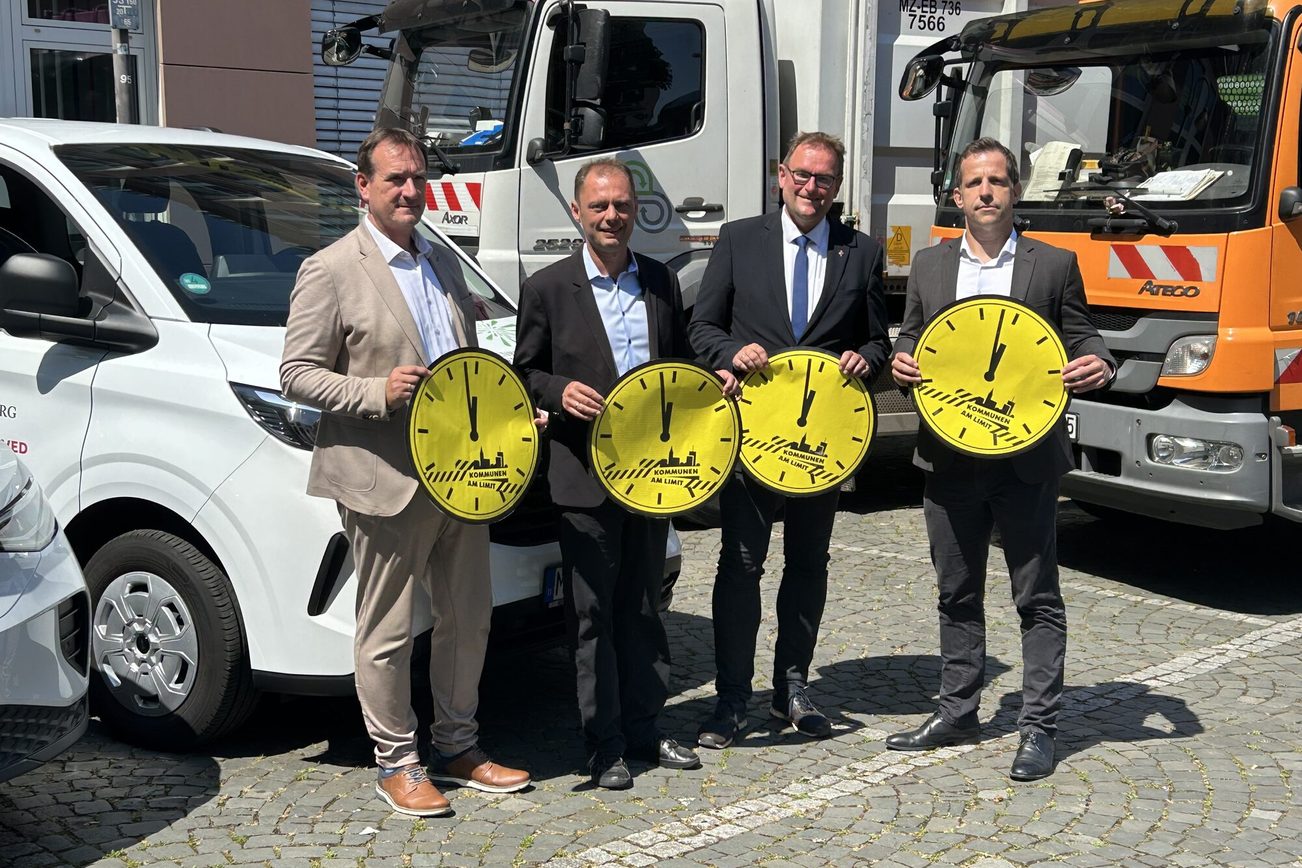
The state capital of Mainz took part in the nationwide day of action against the financial crisis facing local governments. Together with the leading local government associations and within sight of the state parliament and state government, Mayor Haase and Mayor Köbler urged the state and federal governments to implement far-reaching reforms. During a spontaneous visit, Minister President Schnieder assured them that he would present concrete measures to the municipalities immediately after the summer recess.
“Today’s day of action is a powerful symbol of the solidarity among Germany’s municipalities: from north to south, from small to large. Even the economically strongest state capitals are now having to cope with record-high deficits,” says Mainz Mayor Nino Haase, highlighting the national scope of the municipal financial crisis.
Mayor and Finance Commissioner Daniel Köbler is therefore calling for a nationwide concerted effort: “All of this shows that there is a flaw in the system. The federal and state governments must finally ensure adequate funding for municipalities and urgently implement structural reforms. This must certainly also be accompanied by a review of municipal responsibilities.”
Mayor Haase and Mayor Köbler specifically call on the state to take responsibility: “Our appeal is directed at our new state government: The municipalities in Rhineland-Palatinate need not only more money, but also a fair distribution of funds. In this regard, the special challenges faced by large cities—particularly in the social sector—and their cost structures must finally be taken into account. The state must act now and reform the municipal financial equalization system promptly and in accordance with the principle of proportionality.”
In Mainz, the nationwide day of action was jointly organized with representatives of the Association of Cities (Markus Zwick, Mayor of Pirmasens), the Association of Counties (Ralf Leßmeister, District Administrator of Kaiserslautern), and the Association of Municipalities and Cities (Thomas Przybylla, mayor of the Weißenthurm municipal association) and the state capital of Mainz (Mayor Nino Haase and Mayor Daniel Köbler).
Minister President Gordon Schnieder made a spontaneous visit to the press event, which was held within sight of the State Chancellery. He showed great understanding and promised to present measures after the summer break.
There was broad consensus among the local government representatives that the financial crisis facing municipalities is a concern for everyone. After all, it affects citizens in their everyday lives: Municipalities operate daycare centers, build schools, provide social services, ensure affordable cultural offerings, repair roads, operate bus routes, maintain green spaces, and ensure order and cleanliness.
The financial situation of local governments is deteriorating drastically
Just a few years ago, local governments in Germany were able to balance their budgets. In 2022, they had a surplus of 4.5 billion euros nationwide. This was followed by a sharp decline to a deficit of over 30 billion euros in 2025. There is no sign of improvement—the trend remains negative. This is also evident in Mainz, where a deficit of 177 million euros had to be budgeted for 2026—with the deficit rising to 222 million euros within three years.
Even Mainz has to take on debt again now
Thanks to the extraordinary tax revenues in 2021 and 2022, when Mainz developed and supplied vaccines to the world, the city was able to pay off its mountain of old debt. But now—without that one-time windfall, with sharply rising social spending, and with a massive reduction in state funding—Mainz must take on debt again: despite austerity measures, increased revenue, and strong economic growth.
Mandatory tasks are overwhelming local governments
The municipalities’ own potential for cost savings is very limited. They now have little control over their budgets. Many responsibilities are mandated by federal or state law. These so-called mandatory responsibilities now account for a large portion of municipal expenditures.
Local governments are expected to do more and more in the social sector
The biggest problem is the tasks that municipalities are required to perform under the law, without the federal and state governments providing sufficient funding for them. Many areas of municipal spending have doubled over the past 10 years, including child and youth welfare, integration assistance, and long-term care support.
Mainz is feeling the effects of this trend particularly acutely. By 2029, Mainz’s annual deficit in the social services sector alone is projected to rise to over 300 million euros. This would represent a doubling over the course of ten years.
Demands of the German Association of Cities to the Federal Government and the States
1. Emergency aid for municipalities, amounting to roughly the current annual deficit in municipal budgets of 30 billion euros. Specifically, this could be achieved, for example, by increasing the municipalities’ share of sales tax revenue by 10 percentage points, from 2.8 to 12.8 percent. This annual emergency aid may only be phased out once reforms that truly relieve the burden on municipalities take effect.
2. The principle “Whoever assigns the task pays for it” must apply immediately to all transfers or expansions of responsibilities by the federal and state governments. No new tasks without corresponding funding from the federal and state governments! The federal and state governments must no longer pass any resolutions without providing full, dynamic financial compensation to local governments.
3. Relief from social costs—the federal government must contribute much more significantly than before to the costs of child and youth welfare as well as integration assistance. To relieve municipalities of the burden of providing long-term care, long-term care insurance should be expanded into comprehensive coverage.
4. Consistently simplify bureaucracy and processes – bureaucratic processes must no longer unnecessarily tie up cities and citizens. Procedures must be consistently streamlined, and unnecessary requirements must be avoided. Legislation must be designed with practical implementation in mind. New regulations may only be introduced if they are practical, digitally implementable, and manageable in terms of staffing. Documentation and reporting requirements must be significantly reduced.