Sali-Levi House Opens: New Access to the World Heritage Site at Judensand in Mainz
Visitor Center Showcases the History of Medieval Magenza / Opening Ceremony and Community Festival
On Sunday, September 6, 2026, the state capital of Mainz inaugurated the new Sali-Levi-Haus Visitor Center at the Old Jewish Cemetery with an official ceremony followed by a community festival. The building creates a new space for information, interaction, and education at the UNESCO World Heritage Site. A permanent exhibition introduces visitors to the history of medieval Magenza and highlights the significance of Mainz’s Jewish community for European Jewry.
From its elevated location, the Sali-Levi-Haus offers a unique view of the Judensand. From here, visitors can explore the cemetery and its history without compromising the religious significance and dignity of the burial site.
"With the Sali Levi House, Judensand gains a place from which its history can be conveyed in a way that is both understandable and respectful. The visitor center highlights the significance Magenza had for Jewish life in Europe and the responsibility that has arisen from this for Mainz to this day. It invites people from Mainz and around the world to engage with this special place,” says Mayor Nino Haase.
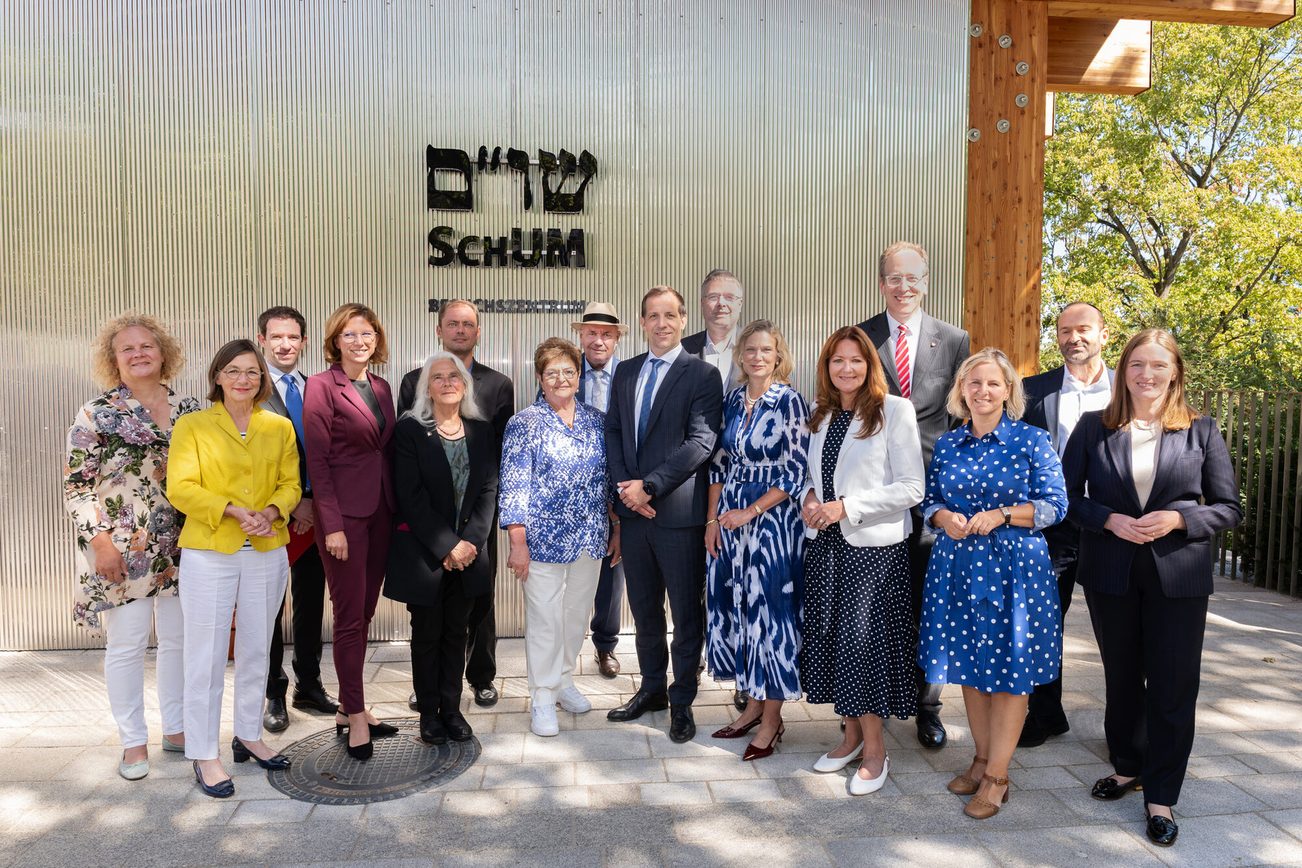
Among the guests at the grand opening, in addition to Mayor Nino Haase, were Prof. Dr. Maria Böhmer, President of the German National Commission for UNESCO; Sabine Bätzing-Lichtenthäler, Deputy Minister-President of the State of Rhineland-Palatinate; Katharina Binz, Vice President of the Rhineland-Palatinate State Parliament; Dr. Katharina von Schnurbein, European Commission Coordinator for Combating Antisemitism and Promoting Jewish Life; and Brian Heath, Consul General of the United States of America. Representatives from politics and Jewish life, from the SchUM cities, as well as from participating institutions and project partners also attended the ceremony.
“For the Jewish Community of Mainz-Rheinhessen, the opening of the Sali Levi House is a special moment. We see ourselves as the successor congregation to the medieval Mainz SchUM congregation and thus bear a special responsibility for this unique heritage. SchUM represents a Jewish history that extends far beyond Mainz and is a significant part of European history. The new visitor center creates a place where this history becomes visible and accessible—a history of scholarship, religious and cultural life, but also of persecution and expulsion,” says Anna Kischner, chairwoman of the Jewish Community of Mainz-Rheinhessen.
“The SchUM communities, with their influence spanning centuries, impressively demonstrate that Jewish life is an integral part of European history. With its designation as a UNESCO World Heritage Site and today’s opening of the Sali Levi House, the many stories told by Mainz’s Judensand and the SchUM sites have found a new home. Making Jewish heritage visible is key to understanding Jewish life today. The fact that Jews in Europe are once again under pressure is completely unacceptable. This must be countered by all means necessary. Combating antisemitism means defending democratic values. “The Sali Levi House, as a center for learning and exchange, will make a decisive contribution to this,” adds Katharina von Schnurbein, coordinator of the European Commission for Combating Antisemitism and Promoting Jewish Life.
One of the Oldest Jewish Cemeteries in Europe
The Old Jewish Cemetery “Judensand” is one of the oldest and most significant Jewish burial sites in Europe. Nearly 1,700 historic gravestones and memorials bear witness to more than 1,000 years of Jewish history. Together with the Jewish monuments in Speyer and Worms, the Judensand forms part of the UNESCO World Heritage series “SchUM Sites in Speyer, Worms, and Mainz,” which was inscribed on the World Heritage List in 2021 as the first World Heritage site dedicated to Jewish history in Germany.
The visitor center is named in honor of the Mainz rabbi Sali Levi. Together with Rabbi Siegmund Salfeld, he brought rediscovered medieval tombstones back to the Judensand. These formed the basis of the memorial cemetery, which was dedicated in 1926 and is celebrating its 100th anniversary this year.
The Sali Levi House is the first visitor center at the SchUM World Heritage Sites and has been built on a platform above the cemetery, the new Siegmund Salfeld Square. Together with the newly designed entrance on Mombacher Straße and the so-called “speaking envelope” consisting of hedges, fences, and viewing windows, it opens up new perspectives on the cemetery. Access to the memorial cemetery remains reserved for people of faith for religious reasons.
Following the design competition in 2019, planning began in 2021; construction of the visitor center and outdoor facilities began in June 2024. The architecture of the Sali-Levi House was designed by Holzer Kobler Architekten, while the open-space planning was carried out by SINAI Landscape Architects. The firm Bach Dolder and Anna Kraus Design Practice designed the permanent exhibition.
The plaza in front of the visitor center was named “Dr.-Siegmund-Salfeld-Platz” in advance. In doing so, the city honors the Mainz rabbi and prominent Jewish historian Dr. Siegmund Salfeld (1843–1926), who served in the Mainz Jewish community beginning in 1880 and made significant contributions to the study of Jewish history.
Community Festival and Opening Week
Following the ceremony, Mainz residents and visitors celebrated the opening with a community festival. Guided tours of the accessible part of the cemetery and through the new permanent exhibition offered visitors their first in-depth insights. Families and children were able to discover the history of the SchUM communities in a playful way at the SchUMobil. At the same time, the Jewish Community opened the New Synagogue for guided tours and a concert.
In the days following the opening, the program will continue with activities for school groups, guided tours of the permanent exhibition as well as of the Old and New Jewish Cemeteries, the sound installation “The Magenza Protocols,” and other events as part of the SchUM Cultural Days.
Further information about Judensand, the Sali Levi House, and the program can be found at judensand-mainz.de (opens in a new tab) and in the enclosed press kit.
- SchUM Visitor Center Press KitPDF-File2,20 MB
- Exterior view of the visitor center (c) Carsten CostardJPEG-File25,85 MB
- Interior view of the exhibition (c) Carsten CostardJPEG-File16,68 MB
- Anna Kischner and Mayor Haase cut the ribbon at the Sali-Levi-Haus (c) Carsten CostardJPEG-File10,92 MB
- Exhibition curator Elke Höllein at the visitor center (c) Carsten CostardJPEG-File16,40 MB
- Group photo taken at the grand opening (c) Carsten CostardJPEG-File18,11 MB
- Visitors at the Old Jewish Cemetery (c) Carsten CostardJPEG-File16,56 MB