New ideas for sustainable nutrition
Environmental tip from the Mainzer Umweltladen

According to the German Nutrition Society (DGE), what we eat has a direct impact on staying within the planetary boundaries. If we want to achieve climate targets and halt species extinction, we need to make significant changes to our diet. But how?
You may have heard of the EAT-Lancet Commission's Planetary Health Diet. This scientifically based diet aims to protect both human health and the health of the planet. The authors emphasize that this is a general recommendation. The actual diet must be adapted to local, cultural, geographical, and demographic conditions. With its new dietary recommendations, the DGE has taken German eating habits into account and included environmental aspects.
For example, the DGE has determined that the proportion of animal-based foods in the German diet is responsible for the following:
- around two-thirds of diet-related greenhouse gas emissions,
- two-thirds to three-quarters of the land required for food production, and
- three-quarters of the food-related biodiversity footprint
Only the diet-related use of freshwater resources is predominantly attributable to plant-based foods. Above all, however, most of the damage caused by our diet does not occur in Germany. Water problems in farming countries are exacerbated when crops that require a lot of water are grown in arid regions.
What is recommended?
The DGE has incorporated greenhouse gas emissions and land use requirements for food, as well as current findings on the health effects of individual food groups, into its mathematical optimization model. In the future, further environmental impacts and food groups are to be integrated; legumes, for example, have not yet been included. A look at the new recommendations confirms that individual health and climate/environmental protection go hand in hand, especially with a calorie-appropriate and largely plant-based diet.
The recommendations are given in grams as daily portions for a healthy adult. However, the actual amounts are calculated on a weekly basis, as it is somewhat difficult to eat 12 grams of egg per day. Added up over a week, this amounts to approximately one egg. For those who would like a quick overview, the DGE has compiled an information sheet with its recommendations. You can find the information sheet in our list of links.
What are the effects?
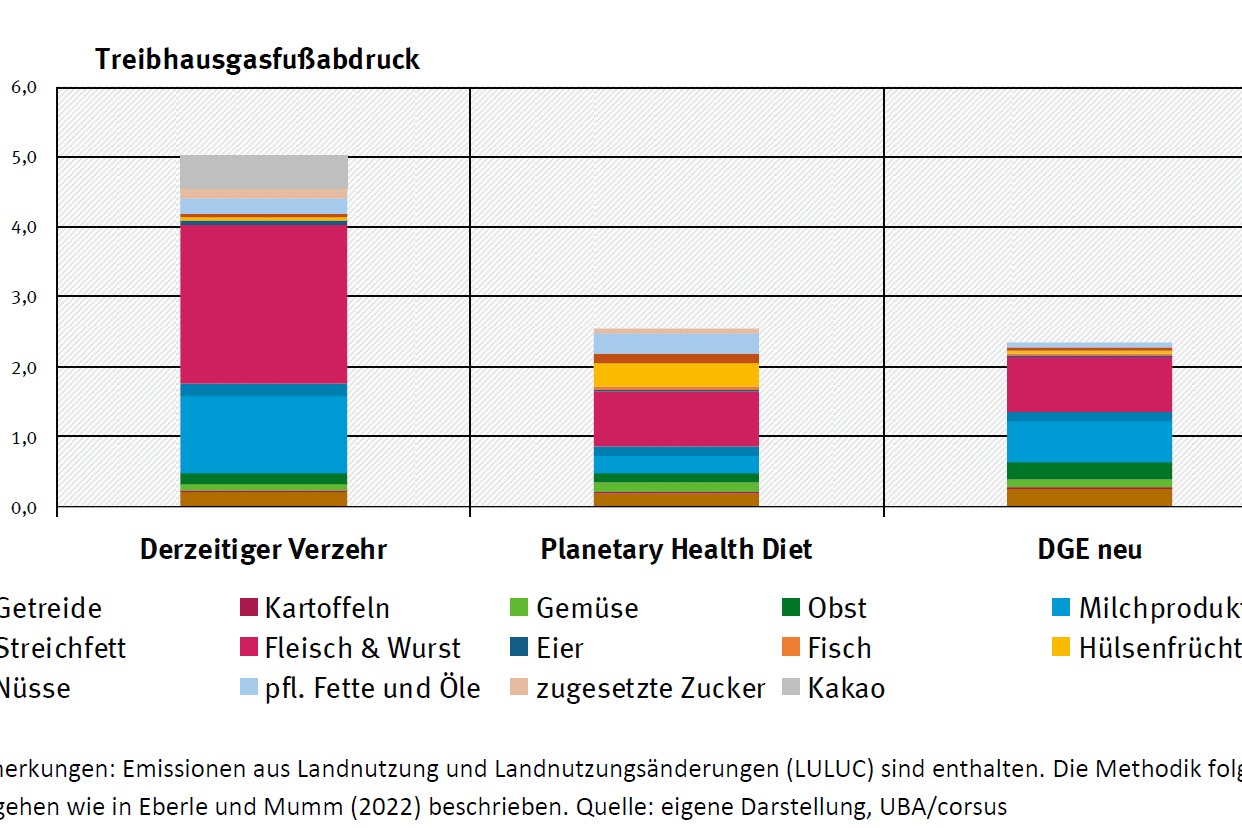
In order to assess the new recommendations of the DGE in relation to other important environmental impacts (e.g., biodiversity, water scarcity, or land use), an initial rough estimate of the environmental impacts of these recommendations was carried out. This was then compared with the environmental impacts of the current average German diet and a flexitarian diet based on the recommendations of the Planetary Health Diet.
The graph shows the environmental impacts in terms of greenhouse gas footprint. Many more comparisons can be found in the fact sheet from the Federal Environment Agency below.
An app for the overview
If you want to improve your eating habits, you first need an overview of what you have eaten and what impact your consumption has on the environment. To make this a little easier, the DGE has developed the "Was ich esse" (What I eat) app. It is available free of charge in the App Store or Play Store. You can enter the type and quantity of food and drinks you have consumed into the app. The data entered is automatically sorted into a food pyramid. In addition to the daily plan, a weekly plan is also maintained, because, as with the egg mentioned above, it is not always possible to consume the recommended daily allowance.
The new DGE recommendations show an ideal situation. Even small changes in your daily diet are a step in the right direction—towards a healthier and more environmentally friendly diet. The "What I Eat" app can help you keep track of your eating habits, so why not give it a try?
Further information is available here:
Contact us
Address
Environmental store
Mainzer Umweltladen
Steingasse 3
55116 Mainz