
Good to know!
Here you will find the most important information on municipal heat planning in Mainz.
What is it about?

Heat supply contributes significantly to CO₂ emissions in Germany. The main reason for this is the use of fossil fuels such as gas and oil, most of which are imported from abroad. The heat transition is a major challenge for the building sector in Germany. In order to achieve climate targets, all buildings must consume less heat and use more renewable energies. A key component on the path to climate neutrality is municipal heat planning.
Find out more here about why heat planning is necessary and useful:
The state capital of Mainz has decided to draw up a municipal heating plan as part of its 100% Climate Protection Master Plan (1423/2022 (opens in a new tab)). The aim is to provide the citizens of Mainz, institutions, and the local economy with planning security for a sustainable heat supply. (opens in a new tab)
Video: How does municipal heat planning work?
Videos and live streams are hosted on the 3Q video platform (3q.video (opens in a new tab)) within the EU in compliance with the GDPR. When you access the content, 3Q sets a cookie to analyze the use of the video content and the platform. By clicking “Share External Content,” you consent to the setting of this cookie and the associated data processing. You can find 3Q’s privacy policy at 3q.video/de/help-center/datenschutz-und-richtlinien (opens in a new tab). You can revoke your consent at any time with future effect in the privacy settings at www.mainz.de/datenschutz (opens in a new tab). The video subtitles are AI-generated.
What is municipal heat planning?
Municipal heat planning is a concept whereby cities and municipalities strategically plan how they can heat their buildings in an environmentally friendly and efficient manner in the long term. The aim is to save energy, use renewable energies, and reduce greenhouse gas emissions. It is based on the Heat Planning Act (WPG), which has been in force since January 1, 2024, and supports municipalities in better coordinating their heat supply and targeting investments. Further information on the Heat Planning Act is available at the following link:
Municipal heat planning is a key measure of Mainz's heat transition. It provides recommendations for the development and optimization of heating networks and for decentralized supply areas. A municipal heat plan is not an implementation plan and does not contain any obligations for building owners.
Who prepares the municipal heat planning for Mainz?
In collaboration with the Department of Parks and the Environment, experienced experts were commissioned to develop the municipal heat plan. Other city departments, as well as representatives from Mainz Public Utilities, were also part of the project group.
How was the municipal heat planning carried out?
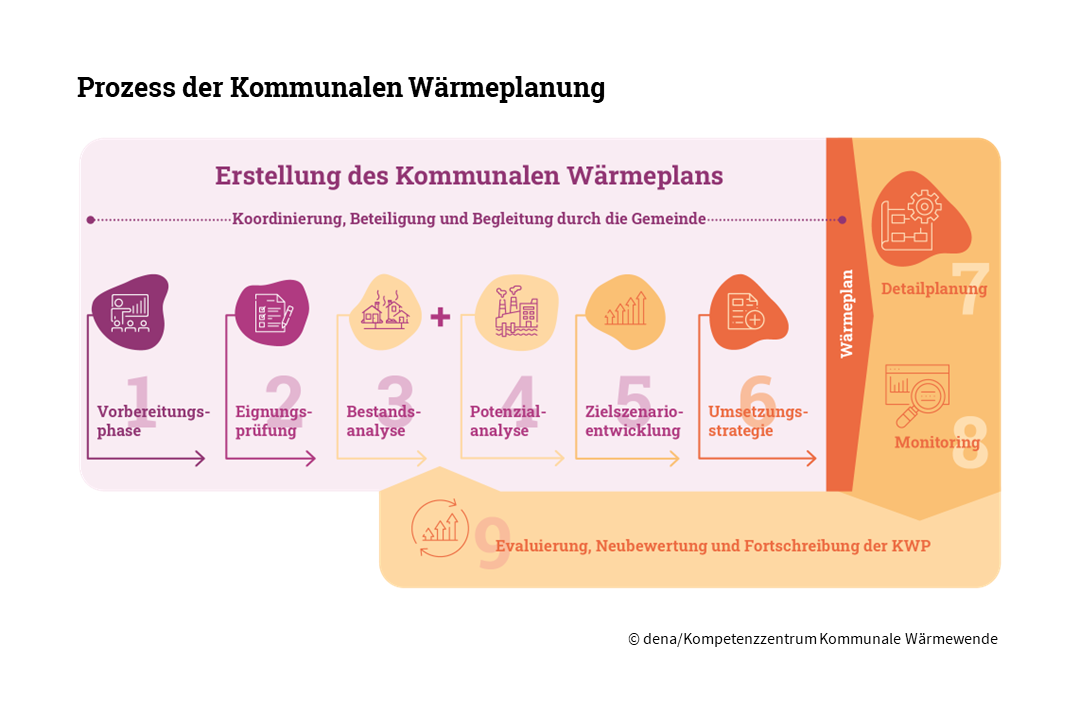
The project group developed the municipal heat plan in four steps:
You can find a summary of the results here:
1. inventory analysis
2. potential analysis
3. scenario development
4. implementation strategy
Throughout the municipal heat planning process, technical and political stakeholders were regularly updated and involved in the planning.
Where does municipal heat planning stand in Mainz?
The municipal heat planning process for the state capital of Mainz was launched in January 2025 and concluded with the City Council’s resolution on June 17, 2026.
You can find the complete Municipal Heating Plan and all appendices here:
You can find the latest updates here:
Contact and further information
Do you have any other questions? Click here to view the FAQs:
Contact us
Address
Team kommunale Wärmeplanung
Grün- und Umweltamt
Grün- und Umweltamt, Haus B
Geschwister-Scholl-Straße 4
55131 Mainz
Postal address
55028 Mainz